Tips and Tricks Archive

May 13, 2013

Questions and Answers - Time Clock MTS Client Software

It seems to be the week for new Time Clock MTS users asking great questions. Here's a few questions I've just been asked about the Time Clock MTS Client software plus some great suggestions.

Question : The client version icons go blue after a short time; on the admin stations the icons next to the staff names stay green or red based on their clock in status; do you know why there is a difference?

Answer : This is the clients going idle to stop them clogging up the network. Whenever an employee clicks their name it will update their status. Look here for more information: http://www.timeclockmts.com/weblog/archives/2012/10/the-time-clock-mts-client-idle-state.html

Question : We also wonder why the client version does not allow for robust administrative privileges like the trial version (after logging in as administrator, of course).

Answer : The client does allow you to run reports and so on but not configure software options, add employees, and so on. This is a design choice in the software.

Question : Can you change it so that you can have multiple administrators logged in at the same time?

Answer : 3) No, you can only have one administrator logged in at once. But as I said above you can run reports from the client computers.

Suggestion : I would like to suggest that the administrators be given access to change the formatting of the "canned" reports without having to export into excel. For example, we have a few fields that we would like bold; it would be great to be able to go into the report settings and input some html code to make those fields format to our preferences.

Answer : Selective formatting of reports is under development right now.

Suggestion: We would also like to see the administrators have power to change certain defaults on the interface screen. Currently each staff member would have to go in to change certain settings (for example punchcard vs. job punchcard, view employee information etc.) when viewing or printing their time sheets. We would love it if we could set defaults so they have fewer things to choose.

Answer : Employees can only view three different reports. This provides them with a good amount of information without overwhelming them with the entire list of several dozen different reports.

Posted by By Mark Nemtsas at 8:22 AM | Comments (0)


May 9, 2013

More Time Clock MTS Network Questions

Some more questions and answers about Time Clock MTS on a Network and some other features of the software.. These questions were asked by the same user who I answered in a recent blog post.

Question: The options set on my computer when I log in as the administrator, are those options pushed to all employees client versions of the software or do I have to go and configure all the settings on all employees computers when I install the software on their computers?

Answer : The client computers will pick up most of the settings from the admin computer. Some settings, such as the web cam and fingerprint settings can be configured at the client computer.

Question: I do not have a webcam on my computer when changing the options as Administrator so I get a msg stating that this can not be enabled. If my employees have a webcam installed, do I have to change this option on their computers and if so how is this done?

Answer : The camera option can be turned on client by client from the client computers. Log into the client as the administrator and go to the Tools->Options->Camera Settings screen and you can set things up there.

Question: When setting up the holidays, I see that there is a check box for a "recurring holiday". If this is checked will the employees automatically receive credit for this day based on the hours entered? If this is the case then I have 2 questions. What if I have a new employee that may not be entitled to the holiday yet, how do I prevent this person from getting paid for the holiday? Second question, what is the recurring holiday lands on a non working day, i.e. falls on a Saturday and we don't work Saturdays, how does this work?

Answer : Yes, employees will get credit for that holiday. Yes, if it happens on a non working day they'll get credit for it. There's no way of restricting a single employee from getting a particular holiday. An employee either gets public holidays or they don't.

Question: I can not alter any of the fields in the "Sick Leave Accrual" section under Options. How do I turn this on?

Answer : You need to create employee types before you can create accruals. Take a look at these articles:

http://www.timeclockmts.com/articles/vacation-accruals.htm
http://www.timeclockmts.com/articles/sick-leave-accruals.htm
http://www.timeclockmts.com/articles/recording-sick-vacation-time.htm


Question: I have the same issue as point # 4 above. How do I turn this on?

Answer : See Above.

Question: If I have an employee clocking in because they arrived early. Is it possible to prevent them from getting paid extra time? So if they are supposed to start work at 8:00 but punch in at 7:40, I don't want them to get paid for the extra 20 min.

Answer : See here to stop employees clocking in too early:

http://www.timeclockmts.com/weblog/archives/2008/11/stopping-employees-clocking-in-too-early.html


Posted by By Mark Nemtsas at 7:09 AM | Comments (0)


May 6, 2013

Time Clock MTS on the Network

You're probably aware you can use Time Cock MTS as a Network Time Clock but I had a bunch of good questions from a new user of the software today and I thought it might be worth repeating his questions and my answers here.

Question: I'm confused on the setup of the software. If I want Time Clock to be installed on a network, which versions of the software gets installed on the various comptuers. i.e. Lets say that I want the main database to be installed on my server, my employees will punch in/our on computer B and I want to administer the program on computer C, what do I install where?

Answer: Install the administrator software on Computer C. Use that to move your Time Clock MTS database to your server. Then install the Time Clock MTS Client software on computer B.

Question: Also, if there are 2 owners of the business, can both people run a version of the software but use the same login? Which version of the software needs to be installed? If these 2 people need to punch in/out also, is there another version that needs to be installed?

Answer: There's only one administrator login. The Time Clock MTS administrator program can also be used to clock in and out.

Question: Am I correct to say that the Administrator version is the version that contains the actual database where all the data is being collected?

Answer: No, it doesn't contain the data but it does install the database when you install it. It can be used to move the database to somewhere on your network so the data can be shared.

Question: If I wanted to run daily backups of the database data, which files would I need to backup?

Answer: You only need to backup the timeclock.mdb file which is what you move onto your server using the Time Clock MTS administrator program.

Question: You install the administrator, then move the database to the location on the server where all users can access it, then set up the client software on the other pc's that will clock in/out with the software. Is that the right sequence? I was always looking for 1 piece of info to start with - I was thinking that you started with a database which you installed on your server, then another piece of software that the administrator used and another for the staff to use. But it's only 2 bits of software, not 3. Is that right?

Answer: Yes, you're right it's two bits of software. Install the admin software on the computer you want to manage the software on and then use that to move the database to your server. Then install the clients on the computers you want those on and connect those to the file on your server. Here's some detailed instructions covering how to install the multi computer version of Time Clock MTS.

http://www.timeclockmts.com/weblog/archives/2010/01/setting-up-time-clock-mts-in-multi-user-mode-ms-access.html


Posted by By Mark Nemtsas at 2:57 PM | Comments (0)


March 29, 2013

The Employee Time Off Request Report

The employee time off request report
The Employee Time Off Request Report

Above you can see the employee time off request report which is a new addition to our employee clockin software. If you're not sure what Time Clock MTS employee time off requests are you can read more about them here or watch a video explaining how employees place a request.

The employee time off request report allows users to break down requests by status and date. The way the report is generated is different to most other reports in Time Clock MTS because it is not configured from the report configuration screen but rather is run directly from the screen administrators use to manage employee time off requests. Here's an image of that screen:

The administrator manage time off requests screen
Managing Time Off Requests - Administrator

The report is run by clicking the button with the printer icon on it. The actual data displayed on the report is determined by what data is displayed on the screen at the time. So, if for example, you're showing requests from All Time (selected from the time period drop down) and only displaying Pending requests (because the Pending checkbox is ticked and the other two boxes are not) then the report will show Pending requests regardless of the date the requests were made.

Another example would be to display all Approved requests from the the previous month. To accomplish this we would select "Last Month" from the time period drop down and check the "Approved" checkbox and uncheck the others. To view the report click the Printer button.

In conclusion if you do need to record and track employee time off requests from your employee punch clock software then the time off request report is an ideal way of reporting on those requests. Don't forget that there's also dozens of other time clock reports available from within Time Clock MTS and one of those is bound to fit your requirements.

Posted by By Mark Nemtsas at 9:19 AM | Comments (0)


March 25, 2013

Punch Clock Software, Punch Card Software

Replace your Punch Clock Machine with Time Clock MTS

Hundreds of companies across the USA and around world have replaced their manual punch clock and punch card machines with Time Clock MTS. This is freeing up their time to run their business better, saving them money through elimination of payroll errors. and reducing payroll costs by stopping punch clock fraud.

"I like the layout. It allows for employees to punch in and out quickly. I also like the CuteWriter option which allows me to send timesheets via email. The product looks great and easy to use."

K.L., Pharmacy Manager

Time Clock MTS Screenshot
Click Image to Enlarge

Punch card and punch clock machines are a thing of the past and should be replaced with a computer punch clock program such as Time Clock MTS. You can completely do away with paper punch cards, the tedious task of collecting them, and the error prone process of manually tallying them up for payroll every week, two weeks, or month. Time Clock MTS will allow you to use any computer in your company for employees to punch in and out quickly, easily, and without error. Our punch clock software will collect your employee time punches into a central database where they can be reported on by your payroll department in just minutes.

As a modern employee punch clock program Time Clock MTS offers much, much more than just a replacement for your punch clock machine. It can also combine different business systems into one solution streamlining your processes and saving you real money. Time Clock MTS can track and report on employee leave and accruals as well as allowing employees to request time off directly within the punch card software. It will also enable your employees to record their time punches against jobs as they clock in or clock out giving you real control over where and how your employees are spending their time.

Eliminate Punch Clock Fraud

Punch clock fraud is believed to add 5 to 10% to the payroll costs of the average business. Mechanical punch card machines can do little to prevent buddy punching, and while modern electronic time clock machines caninclude biometric security these cost upwards of $2,000 per unit. Compare this with the cost of Time Clock MTS which can be setup as biometric time punch software for well under $200 on a single computer. You can further enhance the security of Time Clock MTS to prevent time clock fraud through the use of employee PIN security, our secure online time server, or by taking photos of employees as they punch in or punch out.

Free Punch Clock Software

One of the most exciting aspects of Time Clock MTS is that it can be completely free for a very small business that needs to track the attendance of 3 or fewer employees. And the best thing is, to get hold of our free employee punch clock software you don't have to do anything more than download and install the 30 day trial version of Time Clock MTS. When the 30 day trial period is up the software will automatically change to operate in free mode and you'll be left with free employee punch clock software installed on a single computer that will track up to 3 employees. And it'll remain free forever.

What Are you Waiting For?

Get the Free 30 Day Trial of Time Clock MTS now and start tracking your employee time punches now! There's money to be saved and time to be recovered so that you can get on with the business of running your business!

Posted by By Mark Nemtsas at 8:49 AM | Comments (0)


March 14, 2013

Student Attendance Software

Sometimes it surprises me how Time Clock MTS is used out there in the "wild". For example, it's used in a lot of locations to track student attendance. At one trade and technical school in Miami, for example, it's now being used to track the attendance of all students in the classroom in an effort to replicate real attendance tracking in the work place. This is happening in more than 20 classrooms to track over 600 students attendance at that one location.

Fortunately, Time Clock MTS provides enough flexibility to allow it to be configured to track student attendance while still being simple enough to not burden down users with having to track payroll information too. I thought it might be worth looking at how it could be setup to track student attendance and what reports would be useful in a classroom or school environment.

Time Clock MTS configured as student attendance software

Customizing the Interface to Suit Students

The screens that students would see when logging their attendance in Time Clock MTS can be changed somewhat to suit the classroom environment. The Display Settings screen is where most of the labels on the main screen of Time Clock MTS can be changed. Labels such as the "Employees In", "Employees Out", "Search for Employees" and so on could be changed to reference students rather than employees. The main time clock screen of Time Clock MTS setup as student attendance software might look something like that shown above.

Student Attendance Reports

Almost any of the reports in Time Clock MTS would be fine for monitoring student attendance but clearly most of the payroll data could be safely removed or ignored. Probably the best report to use would be the Punchcard Report but I'd suggest editing various report section templates to remove extraneous information. Report section templates can be changed on the Report Settings Screen. Report section templates that could be edited for clarity would be the employee accruals section (which could really be deleted for tracking student attendance), and the employee payroll details section (where you could remove references to actual money earned).

Time Clock MTS in Schools and Universities

I thought it would be worthwhile concluding with some brief figures on how many schools and universities Time Clock MTS is being used in. At last count, this was something more than 200 different schools or universities. It's safe to assume that some of these are using the software to track staff attendance rather than student attendance. However, I do know that many of them are using it to track student attendance. With the tips I've given above I hope this will make the software even more useful for this purpose.

Posted by By Mark Nemtsas at 9:58 AM | Comments (0)


February 19, 2013

Upgrading Time Clock MTS to a One Client License

I received an email from an existing Time Clock MTS user who has a single computer license. He wanted to upgrade to a one client license but wanted to move the administrator software to another computer and use the original computer as a Time Clock MTS Client. It was a good question so I thought it was worth posting up my reply here for future reference.


System Options Screen - Moving the Existing Database
  1. Share a folder on your network server that is accessible to both computers. Then move your Time Clock MTS database to the folder using the Tools->Options->System Options screen while logged in as the Time Clock MTS administrator. You can move the database by clicking the MOVE button from this screen. See image above for more information.
  2. Uninstall Time Clock MTS from that computer.

  3. System Options Screen - Connect to a Different Database
  4. Install Time Clock MTS on the other computer. Run it for the first time and setup a new password. Log into that Time Clock MTS as the administrator and connect to the database you moved in step one above by going to the Tools->Options->System Options screen and clicking the CHANGE button.
  5. Purchase a one client upgrade for Time Clock MTS. Contact Me for an Upgrade Purchase Link.
  6. Install the Time Clock MTS client on the existing computer, when you run it the first time it should be connected to the database you moved in step one above.
  7. Register both computers with the new registration codes you'll get when you make the upgrade purchase.

There's a couple of things to note with this process. In Step 1, make sure the folder you share gives all Time Clock MTS computers full read/write/create/delete permissions on that folder. In Step 5 the Time Clock MTS client should pick up the settings from the administrator software that used to be on it. However, in some cases it may not and you'll be shown a First Run Wizard that will take you through the process of connecting to an existing Time Clock MTS database.

Posted by By Mark Nemtsas at 7:42 AM | Comments (0)


February 18, 2013

Employee Time Tracking Software

There are three distinct reasons that an employer would have for using employee time tracking software such as Time Clock MTS or Timesheets Lite. These reasons are completely aside from the efficiency and productivity gains that employee time tracking software can deliver, but are more the basic reason why such software would be employed.

Time Clock MTS Screenshot
Time Clock MTS - Click Image to Enlarge

Basic Employee Hour Tracking

Every employer needs know how many hours an employee works during a payroll period and in some localities they need to know what days / times those hours are worked. Employee time tracking software must be able record employee hours, and then report on it in a timely fashion. Ideally the software should provide a number of different methods of recording the employee hours. This could be via use of a mouse and keyboard, a swipe card, a bar code scanner, touch screen integration, or an RFID scanner. All reports must be highly configurable, flexible, and able to be exported to a number of different formats or other software such as payroll software or costing software.

An ideal time tracking system will also provide an amount of post processing on recorded employee hours. This could include daily and weekly overtime calculations, sick time and vacation time accrual tracking, or even automatic break deductions. There may also be ancillary features to help streamline other business processes such as employee tip/gratuity tracking, employee time off requests, preventing employees clocking too early or too late, or even biometric security.

Internal Job Cost Tracking

It's not at all unusual for a business to need to track the cost of internal jobs which will help ensure that jobs are both profitable and give some idea of when they are nearing completion. Employee hour tracking software must provide some means of allowing employees to both record their hours but also to allocate these hours to a particular job. It must do so with a minimum of fuss so as to not provide an administrative burden to the employees. Once the software is recording employee times against jobs it must also provide a means for management to track job labor costs via the reporting system. Again these reports must be able to be exported to a number of different formats, including being able to view job time reports in a spreadsheet program such as Microsoft Excel.

Timesheets Lite Screenshot
Timesheets Lite - Click Image to Enlarge

Recording Billable Hours

Many companies charge the hours their employees spend working on projects directly to their customers. Clearly in this case tracking billable hours is probably one of the most vital administrative tasks such a business can undertake. Employee time tracking software suited to this sort of environment must be particularly strong on the administrative side of the software. Projects that employees can book time to must be easy to create, must be able to have sub-tasks, must allow for budgets and budget tracking, and ideally should allow projects to be categorized. Reports for this sort of software should be much more project / budget focused rather than payroll focused. There must be reports to track project progress against budget, detailed reports showing fine grained detail of how employees have spent their time, and some basic payroll based reports such as a weekly timesheet. Again, as with any good time tracking software all reports should be able to be exported to a number of different formats.

Time Tracking Software from Timesheets MTS Software

Timesheets MTS software has two employee time tracking software programs that are ideally suited to the cases I've discussed above. Time Clock MTS is a simple to use time clock program for employees show need to track their hours and record their time against jobs. It is particularly strong at tracking employee payroll hours and includes a number of payroll oriented features to help improve your payroll process. Timesheets Lite is a project based time tracking program for employees who need to continuously record their time spent on projects or even time their activities as they perform them.

Posted by By Mark Nemtsas at 7:14 AM | Comments (0)


February 9, 2013

Time Clock Software and Salaried Employees


Salaried Employee Time Card Report

I've written about this a few times before but it's worth mentioning again. From time to time I get an email from a user of our employee time attendance software who has noticed that the total time for punches on a report do not add up to the work time in the summary section of the report. Above you can see just such a report. It's an employee punchcard report. You can see that the time punches on the report tally up to 86.27 hours but the total work time reported is 80.08 hours. What's the reason for the discrepancy?

Well it turns out that this employee is set to be paid a salary rather than paid hourly (this is configured on the employee payroll information screen). What's more they are setup for monthly salary. Thus, when Time Clock MTS generated this report it calculated how much of a month the report period was (about 46.2% it turns out). It took this fraction and multiplied it by the standard hours worked per month (173.3 hours per month) and arrived at the figure reported of 80.08 hours as opposed to the time the punches added up to.

If you do have salaried employees and you do want to report on their actual hours worked (as opposed to their calculated pro-rata hours as shown above) then there's a report section template field you can include in the payroll information and employee summary report templates. The <ACTUAL_SALARY_WORK_TIME> field will show the actual time recorded by a salaried employee during a report period. Report section templates and fields can be configured on the Time Clock Report Settings screen.

Posted by By Mark Nemtsas at 8:42 AM | Comments (0)


February 8, 2013

Approving a Time Off Request - Time Clock Video Demonstration

This video demonstration takes the administrator of our time card system through the process of approving an employee time off request. Employees can use Time Clock MTS to place time off requests. These requests are then considered by the time clock administrator for approval or denial. When a time off request is approved the administrator can automatically create time punches for the requested time period and notify the employee of the reason for approval (or denial for that matter). This time clock video demonstration will take you through the entire time off approval process. It runs for 2 minutes and has no sound.

Note that you must have the Adobe Flash player plugin for your internet browser installed to view this video. You can download this plugin from Adobe.

Posted by By Mark Nemtsas at 10:49 AM | Comments (0)


January 20, 2013

Placing a Time Off Request - Video Demonstration

This video demonstration takes time clock employees through the process of placing a time off request. Time Clock MTS allows employees to place time off requests which are then approved or denied by the time clock administrator. Time Clock MTS will automatically notify an employee of a change in the status of their request. The time clock administrator can use the time off request system to automatically create time punches for the time off if the request is approved. This time clock video demonstration runs for 1 minute and 45 seconds and has no audio.

Note that you must have the Adobe Flash player plugin for your internet browser installed to view this video. You can download this plugin from Adobe. There is no sound in this video.

Posted by By Mark Nemtsas at 10:19 AM | Comments (0)


December 31, 2012

Clocking In and Clocking Out - Video Demonstration

This video demonstration takes the new Time Clock MTS user through the two main methods that employees use to clock in and clock out. The first method uses the employee list interface and the second uses the keypad interface. Using Employee PINs is also briefly covered as are some of the reasons why you'd want to use them. I also covered the topic of employees clocking in and out in some detail a week or two back in the blog entry entitled Two Methods to Clock In and Clock Out. This time clock video demonstration runs for just over 2 minutes and has no audio.

Note that you must have the Adobe Flash player plugin for your internet browser installed to view this video. You can download this plugin from Adobe. There is no sound in this video.

Posted by By Mark Nemtsas at 6:54 AM | Comments (0)


December 29, 2012

Time Clock MTS - Running a Payroll Report Video Tutorial

This is the first in what I plan to be a series of video demonstrations explaining how to use various features within Time Clock MTS. This video tutorial gives a brief explanation of the payroll report system within Time Clock MTS, the sorts of criteria that can be used to generate a report and the actual generation of a report. The report structure is then examined briefly as are the various formats that one of our time clock reports can be exported to. The video runs for just under 2 minutes.

Note that you must have the Adobe Flash player plugin for your internet browser installed to view this tutorial. You can download this plugin from Adobe. There is no sound in this video.

Posted by By Mark Nemtsas at 3:48 PM | Comments (0)


December 23, 2012

Two Methods to Clock In and Clock Out

Time Clock MTS includes two distinct methods for employees to clock in and clock out. The first uses the Employee List Interface and the second uses the Keypad Interface. Let's have a closer look at each method of clocking in and clocking out using Time Clock MTS.

Clocking in and Clocking out with the Employee List Interface
Clocking In and Clocking Out with the Employee List Interface

The Employee List Interface

Above you can see the employee list interface of Time Clock MTS. On the left is a list of employees. Next to each employee is a status icon showing the current status of that employee. For example, a green icon indicates an employee is clocked in and a red icon indicates they are clocked out. On the right hand side of the screen are the clock in / out buttons, below that the View My Information button and the status information area. Using the employee list interface to clock in and out is very simple. Just follow these steps:

  1. Click on the employee's name in the list who needs to clock in or clock out.
  2. Depending on their current status either the Clock In or Clock Out button will become active.
  3. Click on the Clock In or Clock Out button to clock the employee in or out. The employee may have to enter their PIN to complete the action.
  4. If the clock in or clock out action is successful the status icon for that employee will change and the status information area will show the details of the clock in or clock out.
Clocking in and Clocking out with the Keypad Interface
Clocking In and Clocking Out with the Keypad Interface

The Keypad Interface

Above you can see the keypad interface of Time Clock MTS. On the left is a virtual numeric keypad and on the right is the employee badge number field (at top) and below that is the status information area. The keypad interface is designed to be used with a touchscreen, or perhaps with a barcode reader, a magnetic swipe card reader, or even a prox card. In fact it can be used with any data reader that can output data to a computer like a keyboard. Using the keypad interface to clock in and out couldn't be any easier.

  1. An employee needs to know their Time Clock MTS badge number to be able to use the keypad interface. All they need to do is enter their badge number using the virtual timeclock keypad (or via a regular keyboard or one of the other data devices I described above). Then they need to click the Enter button. The employee may then have to enter their PIN to complete the action.
  2. Time Clock MTS will then check the status of employee with the entered badge number and clock them in or clock them out as appropriate. The status information area will show the details of the employee clock in or clock out.

So, there you have it. Two different methods for employees to clock in and clock out of Time Clock MTS. Both are simple to do and quick for your employees to learn and one of them will, no doubt, be suitable for your company.

Posted by By Mark Nemtsas at 8:10 AM | Comments (0)


December 20, 2012

A Staff Clock In System

Time Clock MTS Employee List Interface
Click Image to Enlarge

Here's the top ten reasons why I believe every company should implement some sort of staff clock in system. This is by no means a comprehensive list but it's a list of compelling points, you'll ask yourself why you didn't use staff clocking software sooner.

1. So you know Who Is At Work.

Any supervisor needs to know which of their workforce is at work at any one time. This will ensure you have the labor present to accomplish the work that is on hand for the day. Without adequate resources your company cannot deliver the products, processes, or services that your customers expect. Good staff clock in software will deliver you this information in just moments.

2. Who is Here? A Key Requirement in a Business Evacuation Plan.

Occupational safety and health requires that in the event of a fire or other disaster an essential part of any evacuation plan is to know who is or is not present within a building or workplace. A functional staff clock in system can provide this sort of critical information.

3. So you know When Employees Get to Work.

Monitoring staff performance is vital for building a better workforce and a better business. One key performance indicator in any work place is on-time attendance of employees. Clearly tracking this KPI is only possible if there is a staff clockin system in place. Knowing how long your employees are at work is vital for calculating payroll. Obviously you can't determine how long an employee has been at work without knowing when they arrived.

4. So you know When Employees Leave Work.

The natural corollary to the previous point is needing to know when employees leave work. Without this information you cannot know how long your employees are working and you cannot tell which of your employees is performing to standards that you have set for them.

5. Increased Employee Morale.

A good staff clock in system can improve staff morale in a number of ways. Firstly, it can help to reduce payroll errors and the resultant staff frustrations. Secondly, it can provide your employees with more information about their wages, such as vacation owed, overtime owed, and sick time owing. Thirdly, it can provide them with this information quickly and easily rather than making them wait for it. And finally an advanced employee clocking system can provide more than just attendance tracking for your employees. It could provide them with the means to track employee tips, allow them to place and track time off requests, or receive messages directly from your payroll department.

6. To Increase Payroll Accuracy.

Having time and attendance data collected centrally by a computerized clock in system and being able to report on the data quickly and easily can only result in improved payroll accuracy. Accuracy will continue to improve more when you couple this with elimination of the need for double entering employee timesheets, simple automatic overtime and accrual calculations, and decreased administration staff frustrations.

7. To Reduce Administration Expenses.

Collecting employee time and attendance data and processing employee payroll is a necessary function in any business. While neither tasks can add directly to your business profits they can certainly detract from profits if they are done slowly, inefficiently, and inaccurately. An automated time clock system will speed up your attendance data collection. It will reduce the time spent processing payroll and timesheets. And if your staff clock in system is configured correctly it will give you more accurate reports more consistently than any manual system.

8. To Stop Wasting Money.

Excess monies spent on administration expenses associated with tracking your employee time clock data and processing are sunk costs and never recoverable. Clearly a business needs to minimize these expenses so that the cash is available for profit generating activities. Good staff clockin software will reduce your administration expenses saving your business money AND allowing your business to use the cash it does have more effectively.

9. To Work More on Increasing Profits.

The old business proverb says "work on the business not in the business". As I mentioned above attendance tracking and payroll processing is a necessary overhead in any business. It makes sense that time spent on it should be minimized so that your time can be spent on more valuable things. Such as growing a business or increasing profitability. A decent time clock program that allows your employees to clock in and out easily and eases your payroll processing woes will free up your time to start working on your business more rather than just in your business.

10. To Simplify Your Business Systems.

I'm a great believer in simplifying and integrating business systems. Systems should not be a burden for employees to use (or they will not use them) and there should be as few different systems as possible (or employees will find it hard to learn all the systems). A good time clock software system like Time Clock MTS will allow you to integrate and simplify several business systems. This includes employee attendance data collection, payroll reporting, employee time off requests and approvals, sick / vacation time accruals, and employee tip and gratuity tracking.

Posted by By Mark Nemtsas at 9:25 AM | Comments (0)


December 14, 2012

Secure Your Timeclock System Before It's Too Late with Time Audit Logging

Protect your business against employee fraud by using Time Clock MTS security features you may not have been aware of.

Time clock fraud by employees is a real problem. It might be happening right now within your business and you are yet to find out. Today we received an email from a company who has had to get the police involved because an employee had been systematically defrauding the company through manipulation of their time clock system. Don't let this happen to you!

Time Clock MTS has many different security features some of which are turned on by default and some of which need to be turned on by you, the user. An important security feature of Time Clock MTS that you as the administrator can use is audit logging. This feature records the entire editing history of each clock in and clock out event tracking every change and which computer those changes were made from. If the company that has contacted us about their employee time clock fraud had audit logging turned on within their time clock software they could have provided the police with documentation to support any criminal case.

To turn the audit logging system on to monitor your employee activities go to the Tools->Options->Security Options screen and check the box for Enable Audit Logging.


Enable Audit Logging to View the Time Audit Log

Time Clock MTS includes other security features to help you prevent time clock fraud. Some of these include:

Posted by By harrisk at 6:48 PM | Comments (0)


December 8, 2012

A Barcode Employee Attendance System for Under $250

You might think that setting up a barcode employee attendance system is expensive and complicated. If you did think that, you'd be wrong. By my estimation you could setup an old Windows computer with Time Clock MTS, a simple USB barcode scanner, and some "home made" barcode employee badges for under $250. Here's how I'd do it.

1. Designate a Computer to be your Time Clock Computer

Almost every business has computers these days, and in my experience it's not unusual for one of these computers to either be highly under-utilized or retired and switched off all of the time. It's one of these computers that you should use as your time clock station. Cost? In most cases $0.

Total Cost to Date: $0

2. Purchase and Install Time Clock MTS

At the time of writing Time Clock MTS can be purchased for $79. This can track up to 75 employees on a single computer. Once you've installed Time Clock MTS, create an employee for each employee you want to track. You could also create many employees at once very easily using the method I describe here. Once you've created all of your required employees, print out a Badge Number Report from within Time Clock MTS.

Total Cost to Date: $79

Installing a Barcode Font
Figure 1 - Installing a Barcode Font
Click to Enlarge

3. Create Your Employee Badges

Creating barcodes is easy. And free. You can do it from within pretty much any word processor or spreadsheet these days. All you need is a barcode font. Yes, a font, just like Arial, or Times New Roman, or Trebuchet. If you do a Google search for "free barcode font" you'll get a ton of results, and to save you the trouble I did a search and found that this barcode font is free, and works just fine. To install the font just download the ZIP file, unzip it and double click on one of the files with the ttf extension (see the image above). Windows will then auto-magically install the font.

Once the font is installed you can select it from a font selector in your word processor or spreadsheet of choice. You can see below that I created some simple barcodes in Microsoft Word. Note that the barcode font I selected is "Free 3 of 9". Here's the tricky bit. When you are creating your barcodes you want each barcode to correspond to a Time Clock MTS badge number, the same badge numbers we got from the Badge Number Report we printed out in Step 2 above. In the image below I created badges for the numbers 1010 and 1020.

Installing a Barcode Font
Figure 2 - Simple Employee Badge Design
Click to Enlarge

Now the design of the badge is entirely up to you, in the image above I've done a very simple design in Microsoft Word. Given that you're doing this in a word processor or spreadsheet the sky is the limit really. Once the design is complete print out the cards. I'd suggest a heavy card stock of some type and using a laser printer. I'd also suggest laminating the cards if possible. In any event the cost of the cards is going to be minimal. Less that $0.50 each. For arguments sake let's say we're creating 75 badges for 75 employees, giving a cost of $37.50 for the badges.

Total Cost to Date: $116.50

4. Buy a USB Barcode Scanner

Barcode scanners are not expensive items these days. It's a well known and mature technology and the bugs have well and truly been ironed out. All you need to do is ensure that the scanner comes with the right sort of interface (most likely USB) to plug into your PC and that it can read the barcode that you're using. Barcodes come in many different types, with names like Code 39 (or type 3 of 9), Code 128, and EAN 2. The free barcode font we downloaded in step 3 is Code 39. While I do need to warn you to check that the reader will be able to understand your barcode type, in the VAST majority of cases readers support pretty much every type of barcode these days.

The actual type of scanner you buy is entirely up to you but I'd stick with better known brands simply for reasons of after sales support and reliability. I've used Symbol (made by Motorola) and Gryphon (made by Datalogic) USB Barcode scanners many times in the past and never, ever had a problem with them. When I wrote this article these could be purchased from Amazon for $120 per unit with $10 shipping.

Total Cost to Date: $246.50

5. Install the Barcode Scanner and Configure Time Clock MTS

When your barcode scanner arrives all you should need to do is plug it into a USB port on your computer. Windows will most likely take care of the rest. You may need to install some drivers though, consult the documentation that ships with your scanner. Once installed the computer should view any data read by your barcode scanner as exactly the same as that entered by a keyboard. Don't believe me? Try opening up a word processor or Windows Notepad on the computer and scan a barcode, you should see the characters the barcode represents appear in the word processor.

The Keypad Interface
Figure 3 - The Time Clock MTS Keypad Interface
Click to Enlarge

The final step in the process is to configure Time Clock MTS to work in keypad interface mode (see the image above). I've described in some detail how to do that in this setting up the keypad interface mode article. This shouldn't take you more than a few minutes.

Total Cost to Date: $246.50

6. Start Employees Clocking in and Out

Once Time Clock is working in keypad interface mode clocking an employee in or out is as easy as scanning one of the badges you made in step 3 above. When you scan the badge Time Clock MTS will read the badge number and then clock the employee with the corresponding badge number in or out as appropriate. Is really couldn't be any simpler.

Grand Total: $246.50

There you have it, a barcode employee attendance system for under $250. In my experience a company will likely recoup up to $5 per employee per week when they start using a system like this. This recovery includes indirect costs such as no longer having to waste time using inefficient paper based systems and the associated time spent processing the data created by those systems. The recovery also includes direct costs by largely eliminating employee time clock fraud. $5 per employee per week? If you've got 10 employee's you'll get your $250 back in just over a month. 20 employees and you'll get it back in a fortnight. Any more than 20 employees and you should be asking yourself why you're still reading this and you haven't started setting up such a system already.

Posted by By Mark Nemtsas at 2:32 PM | Comments (0)


December 1, 2012

Tracking Lunch Hours

I had a good question from a user of our employee timeclock software about wanting to track the hours employees spend at lunch but still pay the employees for those hours. The solution is to make use of the job tracking features of Time Clock MTS. I thought it would be worthwhile giving a step-by-step example of how you might set this up and how employees would track their lunch hours.

Tracking Lunch Hours Figure 1
Figure 1 - Adding a Lunch Job

1. Create a Lunch Job

Log into the Time Clock MTS Administrator program and go to the Tools->Options->Job Tracking screen. On the Job Tracking screen click the button to create a new job. You'll then be shown the Add/Edit Job screen (see Figure 1). Enter some details for the Lunch Job and give it a job code that can be easily remembered. In this case I gave it the code 9999. Click the Save Job to add the job. You'll be taken back to the Job Tracking screen where you'll see the new Lunch Job in the job list. See Figure 2.

Tracking Lunch Hours Figure 2
Figure 2 - The Job is Created
Tracking Lunch Hours Figure 3
Figure 3 - Turn on Job Tracking

2. Turn on Job Tracking

The next step is to turn on job tracking for each employee that you want to track lunch hours for. This is done via the Employee Maintenance->Edit Employee->Employee Information screen (see figure 3). When on this screen make a selection from the Job Tracking dropdown. If you're not going to be tracking other jobs then you should probably set this to Optional. Don't forget to press the Save Employee button to save the changes.

Tracking Lunch Hours Figure 4
Figure 4 - Switching Jobs

3. Clock Onto the Lunch Job

Clocking onto the Lunch Job is simple. When the employee is ready to take their lunch break, they need to clock out of Time Clock MTS. When they do they'll be shown the Switch Jobs screen (see Figure 4). Have them click the Switch Jobs button. The Enter Job Code screen (See Figure 5) will then be displayed where the employee can enter the Lunch Job code (in this case 9999). When the code is entered correctly click the Enter button to clock onto the Lunch Job.

Tracking Lunch Hours Figure 5
Figure 5 - Choosing the Lunch Job
Tracking Lunch Hours Figure 6
Figure 6 - Clocking Out of Lunch Job

4. Clock Off of the Lunch Job

When the employee is finished lunch and they need to clock out of the Lunch Job have them clock out as normal. Again they'll be shown the Switch Jobs screen (Figure 4). Click the Switch Jobs button again and then when the Enter Job Code screen is displayed the employee just needs to click the Enter button WITHOUT entering a job code. This will put them back on normal Time Clock MTS time.

Tracking Lunch Hours Figure 7
Figure 7 - The Job Punchcard Report

5. Run Reports

Once your employees are tracking their lunch hours you can use one of the job-based Time Clock MTS reports such as the Job Time Report or the Job Punchcard Report. In this example I decided to run the Job Punchcard report which you can see in Figure 7. Towards the bottom of the report you can see that this employee booked 0.95 hours (or 57 minutes) to lunch on November 30.

6. Conclusions

I hope that you'll find that process useful. It can be setup in just a few minutes and allows you to break down the time spend fairly easily. It doesn't have to be restricted to tracking lunch hours though, you could track other break times, or even track the time that employees spend working in different roles inside your company.


Posted by By Mark Nemtsas at 8:00 AM | Comments (0)


November 20, 2012

How to Create Many Time Clock MTS Employees Quickly

Time Clock MTS has some features that allow you to create multiple employees for your time clock system quickly and accurately. This can significantly speed up the process of setting up Time Clock MTS for the first time as well as adding new employees to an existing system. It can also help to greatly reduce data entry errors when creating new employees.

This Time Clock MTS How-To Article takes you through the process of creating four new employee records using the Export Employee Data and Import Employee Data features within Time Clock MTS.

The Export Employees Menu
Figure 1 - The Export Employees Menu

1. Export Your Existing Employees to Microsoft Excel

This process relies on you having some existing employees in your Time Clock MTS database and that you have Microsoft Excel installed on your computer. Log into the Time Clock MTS Administrator program as the admin and go to the Employee Maintenance->Export Employees menu (see the image above).

Confirm Export Employees Action
Figure 2 - Confirm Export Employees Action

2. Confirm the Export Employees Action

Time Clock MTS will ask you to confirm the export employees action (see the image above). Click the OK button to proceed.

Exported Employee Data
Figure 3 - Exported Employee Data

3. View the Exported Employee Data

A Microsoft Excel window will appear containing your existing employee data (see the image above). It is important to realize that Time Clock MTS uses the Employee Badge as the unique identifier for each employee. The consequence of this is if you change the Badge numbers of the employees in your exported data to new numbers and import that data back into Time Clock MTS it considers them to be entirely new employees.

New Employee Data
Figure 4 - New Employee Data

4. Edit the Exported Employee Data

We're going to change the employee name column of each exported employee and (most importantly) give each one a new badge number. You can see what this might look like in the image above. You should note that at this step you could create copies of your employee data rows and create as many new employee records as you like, conversely you could delete export rows and create fewer new employees than you exported. The choice is yours. In this example we exported 4 employees and we're going to create four new ones.

Saving the Employee Data
Figure 5 - Saving the Employee Data

5. Save the New Employee Data

The next step is to save the Microsoft Excel spreadsheet that contains your new employee data. Note the location where you save it because you'll need to know the location in the following steps. In our example I saved the spreadsheet to a folder on my Windows desktop (see image above).

The Import Employees Menu
Figure 6 - The Import Employees Menu

6. Import the New Employee Data Back into Time Clock MTS

While still logged into Time Clock MTS as the administrator go to the Employee Maintenance->Import Employees menu (see above).

The Import Employees Screen
Figure 7 - The Import Employees Screen

7. Select the New Employee Data Spreadsheet

On the Import Employees screen (shown above) click the Import Employees button. This will allow you to navigate to where you saved your new employee data in Step 5. Once you've found it open the file.

Import Employees Complete
Figure 8 - Import Employees Complete

8. Watch the Employee Import Process

Time Clock MTS will now import the new employee data from the spreadsheet. As it imports each employee a message will be displayed on the Import Employees screen telling you whether that employee was created successfully or not. When the process is complete the Import Employees screen may look something like the image shown above. Note that each new employee is reported as being imported successfully.

The New Employees
Figure 9 - The New Employees

9. View Your New Employees

The final step is to exit out of the Import Employees screen by clicking the Exit button. When we are returned to the employee time clock we can see that the new employees are present on the employee list.

Important Note

If you happen to try to import an employee whose badge number matches the badge number of an employee that is already present in your Time Clock MTS database do not worry. The Import Employee process will not import that employee and leave your existing employee information intact.

Posted by By Mark Nemtsas at 6:47 AM | Comments (0)


November 9, 2012

What is the Time Clock MTS Client Program?


The Time Clock MTS Client Program

The Time Clock MTS Client program (see the image above) is used by employees to clock in and out of your employee time clock software. Each Time Clock MTS Client program on your computers is connected to the same database and your employee attendance data is shared between them. Each computer that has the Time Clock MTS Client program installed on them is known as a "client" and you must be licensed for the same number of clients as you have computers with the Time Clock MTS Client program installed on. At least one of your computers must have the Time Clock MTS Administrator program installed on it. This is where your computer time clock software is administered from. If you want to learn how to setup Time Clock MTS on multiple computers then you should read these instructions.

The Time Clock MTS Client program can be downloaded from the Time Clock MTS Downloads Page.

Posted by By Mark Nemtsas at 6:50 PM | Comments (0)


What is the Time Clock MTS Administrator Program?


The Time Clock MTS Administrator Program

The Time Clock MTS Administrator program (see the image above) is used to administer and manage your employee time clock software. It can also be used by your employees to clock in and out. If you're going to have your employees clock in and out of the same computer that you administer the time clock system from then that computer will have the Time Clock MTS Administrator software installed on it. If you're going to use more than one computer to have your employees clock in and out from then the Time Clock MTS Administrator program will be installed on the computer that you wish to administer the software and run payroll reports and so on. The computers that employees just clock in and out from will have the Time Clock MTS Client program installed on them.

The Time Clock MTS Administrator program can be downloaded from the Time Clock MTS Downloads Page.

Posted by By Mark Nemtsas at 6:42 PM | Comments (0)


October 8, 2012

The Time Clock MTS Client Idle State


Time Clock MTS Client in Idle State

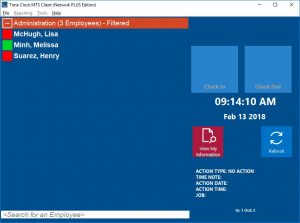
Above you can see a screenshot of the Time Clock MTS Client that has entered the idle state. You can tell this because the status icons have turned blue. Usually these icons are either red (indicating the employee is clocked out) or green (indicating the employee is clocked in). However, the Time Clock MTS client enters an idle state 60 seconds after any activity (such as someone moving a mouse or clocking in or out) to reduce network traffic. When someone clicks on an employee name in the employee list the Time Clock MTS client will query the Time Clock MTS database to get the employee's state to ensure that they can only clock in or out as appropriate.

This idle state behaviour of the Time Clock MTS client is turned on by default, but if you find this confusing it can be turned off via a setting in the Time Clock MTS administrator program. To do this go to the Tools->Options->Interface Options screen and check the No Idle Client State checkbox. This will ensure that every 60 seconds every Time Clock MTS client program on your network will update the status of your employees in the employee list.

Posted by By Mark Nemtsas at 8:53 AM | Comments (0)


October 6, 2012

Why Are the Database Server Settings Disabled?


Disabled Database Server Settings

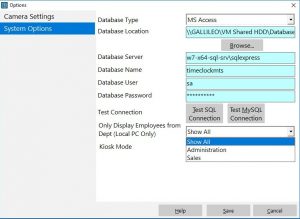
At least a couple of times a month we get emails from users complaining that they are unable to share their Employee Time Clock data between computers because the database settings are disabled in the software. Above you can see a screenshot sent to us by a user showing the disabled database settings.

What's going on here is easily explained. In standard form Time Clock MTS uses an MS Access database, which you can setup on multiple computers and share data by following these instructions. On the screenshot above you'd connect to a shared MS Access database by clicking the Browse button. The settings that are disabled are only for those who want to use Time Clock MTS with a SQL Server or MySQL database backend. They are only available if you've got the correct Time Clock MTS license or if you're using Time Clock MTS during the free 30 day trial period. So the fact that the settings are disabled does not mean you cannot use Time Clock MTS on multiple computers and share data between them.

If you're wondering why you'd want to use SQL Server or MySQL with Time Clock MTS instead of the standard MS Access database backend then you should take a look at this article we wrote a while back discussing Time Clock MTS backend databases.

Posted by By Mark Nemtsas at 9:14 AM | Comments (0)


August 20, 2012

Biometric Time Clock Software and Swipe Cards


A Digital Personal USB Finger Scanner

It appears at first glance that using a time clock software package like Time Clock MTS with magnetic swipe cards or using it with a biometric finger scanner similar to the one shown above are two very different methods to tracking employee attendance. But, In my opinion, they are remarkably similar and really only differ in one key area. Swipe card time clock systems (or for that matter PIN based systems or barcode based systems) rely on each employee having a unique token to identify themselves. Obviously in the case of swipe card and barcode systems the unique employee identifier is encoded on the card or in the barcode. When employees use a PIN the PIN itself identifies the employee. A biometric time clock system has a unique identifier too, some biometric feature of the employee themselves. This could be a voice, a facial pattern or feature, an iris pattern, or most commonly a fingerprint.

It seems to me that the fundamental difference between a time clock system that uses a PIN, swipe card, or barcode to identify an employee and one that uses a biometric feature to identify an employee is the assurance that the actual employee is presenting the unique identifier or someone else is. Obviously magnetic cards and barcodes can be shared between employees and employee PINs can be passed on by word of mouth. Conversely, properly selected biometric identifiers are much, much harder to share between employees. The obvious conclusion is that a biometric time clock system gives employers a much greater assurance that the time clock data they are collecting is a true and valid reflection of actual employee attendance.

Time Clock MTS supported Digital Persona 4500 USB finger scanners are available from Amazon at under $110 and a single computer license of Time Clock MTS is just $69. This affordable combination allows any small business can setup a biometric time clock solution for well under $200, a cost you'd probably recoup in just a few months of payroll savings.

Posted by By Mark Nemtsas at 10:11 AM | Comments (0)


August 9, 2012

Why You Should Move Your Time Clock MTS Database

Here's an email we received recently from a user of Time Clock MTS.

We have been using your time clock software for a few years now and are really happy with how it has been working. About six months ago we upgraded one of our PCs to a newer Windows 7 computer. We purchased a new License for Time Clock MTS for the new machine and it has been working very well up to today. The computer developed a PSU issue and will not boot. We are trying to get the power supply replaced but it may have more issues.

My questions are:

Is there any way to retrieve the clock in and out times without accessing the HDD on the broken computer?

By default our employee timeclock system installs a database on the local disk when you first install the software. If that disk happens to fail and you haven't moved the database then the database (and all the time clock data therein) will be lost. So, no, there's no way this user can retrieve their clock in and out times if they have no access to the HDD of their PC.

To prevent this sort of disaster you should keep your Time Clock MTS database on your network server where it is backed up with all your other files (you do have backups don't you?). Actually moving the database to your network server can be done within Time Clock MTS itself. That process is pretty simple and covered completely in the How to Move the Time Clock MTS Database how-to article.

The moral of the story is, if you have shared network drive that is backed up then you should be using it to store your Time Clock MTS database. This will prevent you from losing your data in the event of hardware failure.

Posted by By Mark Nemtsas at 12:09 PM | Comments (0)


How to Move the Time Clock MTS Database

This Time Clock MTS How To Guide explains the process of moving your employee attendance database to a different location. This is useful if you do not want to store your valuable time clock data on your local computer but rather on your network server where the file is backed up and more secure.

1. Close All Time Clock MTS Clients

The first step is to close all Time Clock MTS client programs. If a client is still connected to the Time Clock MTS database you are trying to move then it will not be able to be moved.


Figure 1 - The System Options Screen

2. Navigate to the System Options Screen

The next step is to log into Time Clock MTS administrator program as the administrator and go to the Tools->Options->System Options screen. On this screen we can see that the database location is on the local c:\ drive. To move this file click the Move button.

3. Select the New Database Location


Figure 2 - Confirm Database Move

Confirm the move action by clicking Yes on the screen above.


Figure 3 - Select a Location

We'll then be shown a folder browser window similar to the one above. In our example we've prepared a network drive that we're going to move the Time Clock MTS to. It can be seen at the lower left of the above screenshot and is called "Time Clock MTS" and has been mapped to the X:\ drive. We should note that Time Clock MTS must have full/read write permissions on the folder that you're going to store the Time Clock MTS database in.

We're going to click on the new database folder now.

4. Save the New Location


Figure 4 - Location Selected

Once the new location is chosen the folder browser window looks like the screenshot shown above. We're going to confirm the move by clicking the Save button.


Figure 5 - Database Move Successful

The folder browser window will now close and Time Clock MTS will display a message similar to the one above informing us that the database has been moved. This message can be acknowledged by clicking the OK button.


Figure 6 - New Database Path

We've now been returned to the System Options screen. We can see that the Database Location has been changed to our selected location.

Moving the Time Clock MTS database is now complete. Note that the next time you run any Time Clock MTS clients you'll be asked to connect to a database and you'll need to navigate to this new location on the client computers.

Posted by By Mark Nemtsas at 11:44 AM | Comments (0)


Purchasing Time Clock MTS

A common question we get asked is whether purchasing our employee timeclock software is a one-time fee or is there a monthly or annual fee to keep using the software. Quite simply you pay once to use the software but there can be on-going support costs if you require our assistance. Here's how it works in more detail:

  • The purchase gives you a lifetime license to use that major version of Time Clock MTS. Currently we're at version 4.1.1, so the major version is 4. If you were to purchase Time Clock MTS now your license code would work until the software went to version 5. But of course, you can keep using Version 4 indefinitely, you do not have to upgrade.
  • The purchase entitles you to one year of email support and access to software updates. If the software goes up a major version within this year you'll get a new registraton code for the new version.
  • Email support after the first year is 25% of the initial purchase price or $20, whichever is higher. Purchasing support is optional, your registration code will keep working whether you purchase it or not. You just will not be entitled to any email support if you do not have a valid support contract.

Posted by By Mark Nemtsas at 11:03 AM | Comments (0)


April 23, 2012

How to Report on Employee Tips


The Tip Summary Report

This Time Clock MTS How To Article covers how you can run reports on employee tips. There are three main employee tip reports in our tip tracking software and this how to article describes each in detail. Employee Tip reports can be run from the Reporting->Payroll Reports screen and you must be logged in as the Time Clock MTS administrator to access the reports. As is normal with most other Time Clock MTS reports you can run any of the tip based reports for a date range, one or many employees, or by department.

The Tip Summary Report

The Tip summary report (shown above) gives a day to day breakdown of tips for each employee. This includes a daily report on tips received directly, credit/debit card tips received, and tips paid out to others.


The Employee Tip Diary Report

The Employee Tip Diary Report

The employee tip diary report gives full details of each entry made by the employee into their tip diary across the reporting date range. Totals are then displayed for each type of tip over the reporting period. This report is very similar to Form 4070A Employee's Daily Record of Tips which is available from the IRS.


The Employee Tip Diary Summary Report

The Employee Tip Diary Summary Report

The employee tip diary summary report produces a very easy to read summary of the employee tip activity over the selected reporting range. Totals are displayed for each type of tip over the reporting period. This report is very similar to Form 4070 Employee's Report of Tips to Employer which is available from the IRS.

Posted by By Mark Nemtsas at 12:30 PM | Comments (0)


April 17, 2012

How to Clock Out All Employees


The Edit Times Screen

This Time Clock MTS How To Article covers how the Time Clock Administrator can clock out all employees that are currently clocked in quickly and easily. This can be especially useful at the end of the work day to clock out any employees that may have forgotten to clock out when they left work for the day.

To clock out all employees that are currently clocked in just follow the steps below..

  1. Log into Time Clock MTS as the administrator. How you log in as the administrator was covered in this Time Clock MTS How To Article.
  2. Go to the Tools->Edit Times screen and you'll be shown the screen at the top of this article.
  3. Click the Clock Out () button and choose the Clock Out All Employees option from the menu that pops up.
  4. Confirm that you want to clock out all employees in the confirmation window that is then shown.
  5. All employees that are clocked in will be clocked out of Time Clock MTS

Posted by By Mark Nemtsas at 2:02 PM | Comments (0)


April 5, 2012

Union Bank Online Payroll Integration

We've just had a request from a Time Clock MTS user who wanted to export their time clock data to Union Bank Online Payroll. Here's the steps that need to be taken to produce a data file suitable for importing to Union Bank Online Payroll.


Figure 1

1. Map Employee Names and ID's Correctly

Time Clock MTS uses only one field for employee's names while the Union Bank Online Payroll system requires a first and last name. To get around this you must name your Time Clock MTS employees using the form LastName,FirstName. It is vital that you get the comma in between the last and first name. You can see in the image above that the employee is named Jones,Bill.

The second thing to ensure is that the Time Clock MTS employee Badge ID matches your Union Bank Online Payroll employee numbers exactly. If this is not done then the time clock data for that employee will not be able to be imported to your payroll system. Above you can see that the employee Badge ID is 1010, this must be the same as the Union Bank employee number.


Figure 2

2. Export Data Using the Pre-Defined Union Bank Online Payroll Export Format

The next step is to actually export the data. This is done from within Time Clock MTS on the Reporting->Data Export->Export Data screen (shown above). Use the selection boxes on the left to choose what employee data you want to export. The date selection buttons on the top right allow you to select the date range that you want to export time clock data for. When you are happy with both the employee selection and the date range click the Export Data button to start the data export process. When the export is complete a Notepad window will pop up and you'll see your exported data (see the image below). You can now save this file with the correct name and file extension required by Union Bank Online Payroll and import it into your payroll system.


Figure 3

Posted by By Mark Nemtsas at 1:50 PM | Comments (0)


March 12, 2012

How to Move Time Clock MTS to a New Computer

Probably one of the most common questions I get asked is how to relocate Time Clock MTS to a new computer. This might be because a computer is being upgraded or perhaps because a computer has failed (or even been stolen). There's some information you need to collect before you undertake this process.

  • Determine where your employee time clock database is. By default this is on the same computer that Time Clock MTS and is here: C:\Program Data\Time Clock MTS\Database\timeclock.mdb. If your old computer is running Windows XP then the file is here: C:\Documents and Settings\All Users\Application Data\Time Clock MTS\Database\timeclock.mdb. In either case you'll need to Show Hidden Files and Folders to see the folder where your database is.
  • You may have moved the database to your network in which case you will need to locate the file using the System Options screen.
  • If you were using MySQL or SQL Server as a backend database then note down the database connection details on the System Options screen.
  • You'll need your Time Clock MTS registration code. This was emailed to you when you purchased Time Clock MTS or can be retrieved using our Registration Recovery page.
  • You'll need a copy of the Time Clock MTS installation file. This can be downloaded from our website or you may have made a copy of the installation file when you purchased the software.

Once you've gathered all that information here's the steps you need to go through to move Time Clock MTS to a new computer.

  1. Install Time Clock MTS on the new computer using the installation files.
  2. Run Time Clock MTS on the new computer and register it with your registration codes using the Help->Registration Details screen. Note that if you purchased Time Clock MTS prior to November 2012 your registration codes will not work with the software on our website and you'll need to purchase an upgrade to the latest version. Contact us for upgrade pricing information.
  3. If your old Time Clock MTS database location was on your old computer in the default location then go to step 4. If your old Time Clock MTS database was on your network then go to step 5. If your old Time Clock MTS installation was using SQL Server or MySQL as a backend database go to step 6.
  4. Close down Time Clock MTS and copy the timeclock.mdb file from the old PC to the new PC into the folder c:\Program Data\Time Clock MTS\Database. Overwrite the file that is there. Re-start Time Clock MTS and you should see your old data. You're now finished moving Time Clock MTS to a new computer.
  5. Run Time Clock MTS on the new computer, log in as the administrator and go to the Tools->Options->System Options screen. Click the Change button and navigate to your Time Clock MTS database which is stored on your network. Click OK to save the change and you'll now see your old data. You're now finished moving Time Clock MTS to a new computer.
  6. Run Time Clock MTS on the new computer, log in as the administrator and go to the Tools->Options->System Options screen. Enter the SQL Server/MySQL database connection details and click the Test Connection button and confirm that the details are correct. Change the Database Type dropdown to the correct database type and click OK to confirm the change and you'll now see your old data. You're now finished moving Time Clock MTS to a new computer.

As always, if you have any problems please contact us for further help.

Posted by By Mark Nemtsas at 12:45 PM | Comments (0)


March 10, 2012

Using Time Clock MTS with Two Different Databases

We've had an interesting question from a Time Clock MTS user who uses the software with two different databases to track two distinct departments in their workplace. The user asked if there was an easier way to have the Time Clock MTS administrator program connect easily to the two different databases with out having to make use of the Change button on the System Options screen. It turns out there is an easier way. Here's what we suggested (these instructions will not work on Windows XP).

1. On the Time Clock MTS administrator program make two copies of the file:

c:\Program Data\Time Clock MTS\timeclock.ini

And call them timeclock_location1.ini and timeclock_location2.ini

2. Open up both of these files in Windows Notepad and change the setting DatabaseLoc in each file to the path to your two Time Clock MTS databases.

3. Save both files.

4. Create a batch file and enter the following commands into it.

copy "c:\Program Data\Time Clock MTS\timeclock_location1.ini" "c:\Program Data\Time Clock MTS\timeclock.ini"
"c:\Program Files (x86)\Time Clock MTS\timeclockmts.exe"

Save the batch file as "timeclockmts_database1.bat".

Note: If you're not running a 64 bit version of Windows use the path c:\Program Files\Time Clock MTS\ rather than c:\Program Files (x86)\Time Clock MTS\timeclockmts.exe.

5. Create another batch file and enter the following commands into it.

copy "c:\Program Data\Time Clock MTS\timeclock_location2.ini" "c:\Program Data\Time Clock MTS\timeclock.ini"
"c:\Program Files (x86)\Time Clock MTS\timeclockmts.exe"

Save the batch file as "timeclockmts_database2.bat".

Note: If you're not running a 64 bit version of Windows use the path c:\Program Files\Time Clock MTS\ rather than c:\Program Files (x86)\Time Clock MTS\timeclockmts.exe.

6. Create a Shortcut to both batch files on your Windows desktop. Call one "Time Clock MTS Database1" and the other "Time Clock MTS Database2".

7. All you need to do to open up Time Clock MTS connected to either of the two databases is double click on the appropriate shortcut.

These instructions require more advanced computer knowledge than Time Clock MTS usually requires of it's users but it's a complex setup required by very few. If you're unclear about anything in this article just Contact Us and we'll try to help you out.

Posted by By Mark Nemtsas at 10:32 AM | Comments (0)


February 8, 2012

Time Clock Software for Libraries

Over 10,000 companies are currently using Time Clock MTS as the system to keep their employees' time and attendance data properly recorded. Out of the thousands of users, 40 of these are libraries. As large libraries have several librarians who work to assist members of the library, keep the books in order and provide advice for anybody who needs it, it can become difficult to keep track of each individual employee. With a good time clock tool, the librarians, cleaners, managers and anybody else working at the library can be added to the system, where data such as payroll, overtime pay and vacation and sick time accruals can be logged.

Both public libraries and private libraries must be kept very organized in order to continue to provide a great place for people to access books of all types. Very often, there are thousands of books within a library that are kept in alphabetical order and different categories. Without order, it would be very difficult to walk into a large library and find the books you're looking for. Just as the books and the appearance of the library is kept perfectly in order, the employees' information must be organized properly behind the scenes. For anybody searching for time clock software for libraries, Time Clock MTS may turn out to be the perfect system to use.

Posted by By Mark Nemtsas at 2:32 PM | Comments (0)


January 17, 2012

How to Setup Weekly Overtime


Overtime Settings Screen

When running a business with several employees, one of the things you might need to do is setup weekly overtime. Time Clock MTS allows you to do this without having to worry about calculation errors. Once you've entered the required information, the time and attendance tool will work out the rest and help you to get an accurate and reliable calculation of all your employees' wages.

This Time Clock MTS How To Article is a step-by-step guide for setting up weekly overtime for your employees using Time Clock MTS.

  1. Start off by logging in as the administrator. This can be done by selecting File -> Log In As Administrator menu.
  2. Select Tools -> Options from the menu bar at the top of the window. Once a new window has opened, have a look down the left-hand menu and choose "Overtime Settings"
  3. Check the box titled "Pay Weekly Overtime". You can then type in how many hours you want the employee(s) to work in the week before receiving overtime pay. For example, if you choose 40 hours, the employee(s) will be paid regular pay for the first 40 hours and then overtime pay for the hours worked after that.
  4. Choose the employee for whom you want to set the weekly overtime pay. Select Employee Maintenance -> Edit Selected Employee.
  5. Once the new window opens, select "Payroll Information" from the left-hand side and look for a box on the right-hand side labeled OT 1 Rate / hr. Type in the amount that you want the employee to receive for each hour worked overtime.

It's very easy to manage your employees and their payroll information using Time Clock MTS. An efficient time clock tool will come in handy for a lot of things and will help you to easily pay your employees with the assurance of having accurate calculations.

Posted by By Mark Nemtsas at 12:26 PM | Comments (0)


January 9, 2012

Free Time and Attendance Tools

This website contains a number of free time and attendance tools that can make the task of tracking your employee's time and attendance data much simpler. The first tool is Time Clock MTS itself. If you've got three or fewer employees and want to use the software on one computer then Time Clock MTS is the perfect free time and attendance tool.

If you're looking for something a bit simpler then we're happy to provide you with our free time card calculator. This 100% online tool allows you to enter your attendance data for a week and it will total up your number of work and break hours. You can then print your time card for later reference.

Finally, if you're just after a very basic free time and attendance tool to record your attendance data you might like to take a look at our free timesheet templates. These well laid out timesheets are available 100% free to download in several popular file formats including Microsoft Word, Microsoft Excel and Adobe PDF. Once downloaded they can easily be printed out and supplied to your staff to record their timesheets.

Of course if you're wanting a more advanced (but not free) time and attendance tool you should take a look at our time clock software, Time Clock MTS. It's suitable for most businesses, small and large and is currently being used by many thousands of companies around the world. If an online time and attendance tool is more suitable to your requirements then try signing up for a free 30 day account of Online Time Clock MTS.

Posted by By Mark Nemtsas at 1:44 PM | Comments (0)


January 8, 2012

How to Setup Daily Overtime


Overtime Settings Screen

If you've got several employees in your business who are receiving different amounts of hourly pay, it can be difficult to keep track of it all manually. Time Clock MTS is a simple and easy time clock system that helps you manage the information of all your individual employees.

Overtime is one of those things that's well-known for getting slightly confusing. However, with a effective and easy-to-use time and attendance tool, you can set the hourly overtime rate for each employee (even if it varies from one employee to another) and let the computer work out the rest!

This Time Clock MTS How To Article is a step-by-step guide for setting up daily overtime for your employees using Time Clock MTS.

  1. Log in as the Administrator. You can do this buy choosing File > Log In As Administrator. Tap in your password and you're ready to go.
  2. Once you're logged in, select Tools > Options. A new window will open and you'll see a list on the left-hand side. Choose Overtime Settings from the list.
  3. Set the amount of hours the employees must work before receiving overtime pay. You can do this by checking the box next to "Pay Daily Overtime (OT Rate 1)" and then typing in the number of hours. For example, if you type "8" in the box, this means that the employee has to work eight hours before starting to receive overtime pay. Click the Save button to save the changes and close the Options window.
  4. The final thing to do is to actually set the hourly overtime rate. To do this, start by highlighting the employee on the "Employees" list. Select Employee Maintenance > Edit Selected Employee. A new window will open and you should see a list of four different categories on the left-hand side. From this list, choose "Payroll Information". Look for "Hourly Payments" half way down the page on the right-hand side of the window.
    Type the hourly overtime rate in the box labeled "OT 1 Rate / hr" and click "Save Employee".

Posted by By Mark Nemtsas at 7:37 AM | Comments (0)


January 2, 2012

Setting Up Time Clock MTS in Multi User Mode - SQL Server

Getting Time Clock MTS to work with SQL Server or SQL Express isn't too difficult. This article takes you through the process of doing so and should have you up and running in fairly short order.

1. Creating the SQL Server Database

The first step in setting up Time Clock MTS to work with SQL Server is to create a database using the standard employee attendance database (MS Access) as a template. To accomplish this you must have the Administrator version of Time Clock MTS installed, you must have an accessible installation of SQL Server (or SQL Express) and you must have installed SQL Server Management Studio.

  1. Using SQL Server Management Studio (SSMS) create a new database that Time Clock MTS will use.
  2. Right Click on the new database in SSMS and select the Tasks option and then select the Import Data option. This will start the SQL Server Import and Export Wizard.
  3. Click Next in the Wizard and choose the Data source as "Microsoft Access".
  4. Click the Browse button and navigate to your Time Clock MTS Access database. This will most likely be in this location: c:\Program Data\Time Clock MTS\Database\timeclock.mdb. However, if you've changed the location then you'll know where your file is. Remember if you cannot find the directory that you might have to Show Hidden Files and Folders to see it.
  5. Click the Next button in the Wizard and choose the SQL Server location, database, and login details and then click the Next button.
  6. The next step of the Wizard allows you to either copy your data directly from the Access database to you SQL Server database or generate a script that you can run later. The choice is yours but in this case we'll copy the data directly. Click the Next button.
  7. This step allows you to choose which tables you want to copy from the MS Access database. Choose all of them and click Next.
  8. Choose Run immediately and click Finish.
  9. SSMS will now display a progress window showing you how the import data process is going. Hopefully it'll go smoothly and you'll have a functional SQL Server database that Time Clock MTS can work with.
  10. In some cases the import process does not create the table primary keys and identity columns properly. This is easily rectified using SSMS. Each table created by the import process has a column called lngID, this column must be the table primary key and must be set as the table identity column. You can see what this looks like in SSMS by viewing this image.
2. Configuring the Time Clock MTS Administrator Program to Work with SQL Server
  1. If you're running the 30 day trial of Time Clock MTS or you're a licensed user who purchased Enhanced Database Support then you'll be able to connect Time Clock MTS to a SQL Server database.
  2. Run Time Clock MTS and log in as the administrator and go to the Tools->Options->System Options screen.
  3. Configure the SQL Server details on this screen. You'll need to know your server name (or IP address), your database name and your SQL Server login details. Note that the SQL Server user must have permissions to add, modify, and delete both data and tables.
  4. When you're happy with the server details click the Test SQL Connection button and check that a connection can be made to the database.
  5. Select "SQL Server" from the Database Type drop down and then click the Save button to save the changes.

Warnings: If there's a red box covering the server detail fields then you're not licensed for Enhanced Database Support. You should Contact Us for help.

3. Configuring the Time Clock MTS Client Program to Work with SQL Server
  1. If you're still in your Time Clock MTS trial period or if you chose the "Enhanced Database Support" option when you purchased Time Clock MTS you'll be able to connect the Time Clock MTS client program to a SQL Server backend database.
  2. Install and run the Time Clock MTS client software.
  3. The first time you run the Time Clock MTS client software you'll be shown the Database Connection Wizard.
  4. Selected the SQL/MSDE database option and enter all of the appropriate database server details into the fields provided. When you're happy with the details click the Test Connection button to make sure you've entered the details correctly and that you can make a connection to the database. Remember that the SQL Server user must have permissions to add, modify, and delete both data and tables.
  5. Click the Wizard finish button and when you're done the Time Clock MTS client should be connected to your SQL Server database.

Posted by By Mark Nemtsas at 8:25 AM | Comments (0)


December 13, 2011

Free Business Time Clock Software

If you're running a small business, you might be wondering how you can effectively manage your employees without dipping too far into business funds. As other business owners may tell you, using a time clock system greatly increases the accuracy of employee payroll, thus allowing you to manage the business in a better way. Time Clock MTS can provide a small business with free business time clock software, so there's no expense involved. This software gives you a free and easy way to track employee attendance. People often expect a cost to be attached to almost everything; however, Time Clock MTS is a quality time clock system that allows you to track and record the attendance and information of up to three employees, completely free of charge.

Apart from tracking their attendance, you can easily track sick and vacation time. When each employee has different vacation times throughout the year, it can become confusing to work out the payroll and attendance manually. This free business time clock software will calculate the payroll automatically, even if you are paying employees different hourly rates throughout the week.

One feature of Time Clock MTS that many people find useful is the ability to generate as many reports as you need within seconds. This enables you to see the performance of one or many of your employees over a period of time.

A reliable time clock system will encourage better productivity from your employees. This is mainly due to the fact that a time clock tool like Time Clock MTS is very accurate and records the exact times that employees clock in and out. It discourages bad habits such as buddy punching, and as a result, the workplace will seem much more fair, which will encourage other employees.

Free business time clock software like Time Clock MTS is an ideal option for small businesses with three employees or less. The software is free forever as long as you only have three employees, and you will get free updates all the time, just like those who use the full version.

Using this free business time clock software is very simple, and it will greatly improve your time and attendance tracking efficiency. When the 30-day trial is up, it will automatically switch to free mode. If you decide that you want to stop using the free mode and use the full version, all you need to do is purchase the software and install it on as many computers as necessary. Installing Time Clock MTS could be a big step forward for any small business. You can start off with the free mode and choose to upgrade whenever the business starts to thrive and hires more employees. It is very beneficial to have a time clock system that has the ability to grow along with your business.

Posted by By Mark Nemtsas at 12:05 PM | Comments (0)


December 2, 2011

Improving Payroll Accuracy with Time Clock Software

One of the main reasons that employers choose to use time clock software is because of the many faults and errors that occur when manually calculating employee payroll information. As time clock software can help to eliminate human error, it can save the business real money each year. The money that is saved can then be used for something else that will help the business to grow. Although you will usually pay a monthly, annual or one-off fee for the time clock software, you will find that you will still save much more money than you would if you continued to experience payroll errors. Research has shown that payroll errors cost large businesses thousands of dollars per year; therefore, many consider a time clock tool to be a good investment.

Elimination of Buddy Punching

A time clock system like Time Clock MTS will help eliminate buddy punching in the workplace. "Buddy punching" is when an employee clocks in another employee before they have actually started working. This is very common in the work place with older time clock systems and methods of clocking in and out, which allow employees to do this. It is mainly done if an employee is going to be late but doesn't want to miss out on their pay. Purchasing time clock software that doesn't allow buddy punching will motivate employees and save the business money, as employees will not be receiving pay for hours that they haven't worked. Eliminating buddy punching from the workplace will automatically improve the payroll accuracy a great deal.

Correct Application of Overtime Rules

When employees are paid extra for overtime, it becomes very tempting for them to take advantage of this. If it is not properly managed and monitored, you may find that the business is paying employees overtime pay during hours that they do not deserve it. As a result, many of the general overtime rules are being broken each day, making the payroll records even more inaccurate. This incurs unnecessary costs for the business that would not have to be paid otherwise.

A good time clock system will ensure the correct application of overtime rules, so you won't be left to sort out employee payroll information that has been miscalculated.

Elimination of Data Entry Errors

It can often be easy for employees to make data entry errors when clocking in and out and recording information, especially when they are rushing to finish quickly. Using a time clock system is much easier and eliminates many of the main problems you may encounter, including data entry errors. Various pieces of information need to be included in the time clock software, including regular and overtime hours, both of which need to be recorded regularly. If the software that you have can do this accurately, the business can save money and time due to errors.

A good, reliable time and attendance tool can make a significant difference to your business. As well as saving the business money (the main reason that many employers choose to buy them), it will encourage employees to work harder and ensure that you are always able to access correct information on the system.

Posted by By Mark Nemtsas at 7:22 AM | Comments (0)


November 18, 2011

Using Time Clock MTS as an In/Out Board


The Employee Status Report

Businesses have been finding ways for their employees to clock in and out for many years. From ID cards to finger prints, there are a huge range of options for small and large companies looking to get a device or some sort of software to keep a record of who is working and who is not. In/Out boards are an example of this type of device, and they are used in the work place for a whole variety of reasons.

1). An In/Out board provides easily accessible information about other employees. The contact details and working hours of employees are available to view, and this allows the business to operate in a much more smooth manner. The business can provide their customers with the contact details of employees and people that they may need to get in touch with about a certain aspect of the company.

2). It allows employers and other employees to know exactly who is inside the building in the case of an emergency. The In/Out board will quickly show the names of employees who are still on the premises, which means that other members of staff can alert everybody of the emergency and ensure that each person is safe.

While In/Out boards are very useful and are popular with large and small businesses, it does not change the fact that employees do not always find them easy to use. Physically manipulating the board can be extremely time consuming, and employees often cannot be bothered to use up so much time, especially if they have entered the building through another entrance where the In/Out board is nowhere to be seen. Employees will usually contact somebody else within the building, for example, the receptionist, who will change the board; however, even this can take up a lot of time if there are other tasks that the receptionist must complete.

Time clock software, on the other hand, is very easy for all employees to use when clocking in and out. Most businesses have stated that they find calculating payroll, sick pay and other figures very time-consuming. Software time clock systems will do all the calculations for you, so you can save time and do something else rather than spend several hours working out figures.

Time clock software like Time Clock MTS often provide you with support from forums and the product's website. Time Clock MTS is updated regularly to give you ease of use and to ensure that nothing is outdated, giving you the best experience using a time clock system. Only authorized PCs can use the software, so you don't have to worry about unauthorized sources accessing private information.

Time Clock MTS is a computerized time clock system that allows any number of employees to clock in and out with ease. The Employee Status Report is a feature of Time Clock MTS and is used by employers to see who has and who has not been in work over a certain period of time. You can view all the employees who are clocked in at a certain time and all the employees who are clocked out. You can also view the most recent employee notes that have been added to the system.

As well as being used by businesses for many other things, Time Clock MTS can be very useful and effective as an In/Out board.

Posted by By Mark Nemtsas at 12:36 PM | Comments (0)


November 5, 2011

Time Clock Software without the Timeclock

Time clocks have come a long way since they were first invented in 1888. Many companies have become reliant on them in order to calculate employees' wages, vacations, overtime pay and many other factors. Nowadays, most businesses look for easy-to-use, hassle-free and cost-effective time clock systems that they can introduce into the workplace to avoid any possible mistakes with calculations.

How did traditional time clock systems operate?

First invented in the 19th century, time clocks were introduced to serve exactly the same purpose that they serve today - recording the hours that employees have worked and calculating the wages owed to each employee.

Traditional time clocks operated with the use of time cards. The cards had areas marked out on them and the employees would punch them to record the hours worked. The employee was the one responsible for doing it correctly; therefore, it was often very easy to make mistakes. As time went by, more advanced time clocks were devised, and these required even more advanced time cards.

By contrast, there were software-based time and attendance tools invented which did not require the time cards. Computers were used instead, and this type of employee attendance system soon became very popular with businesses across the world. The software-based systems immediately reduced the number of errors that were made by employees when clocking in and out.

Mechanical machines have now become a thing of the past for the vast majority of businesses, and computers are widely used in many places of employment. Most of the time and attendance tools that are used today only require employees to either log onto their account, swipe a card or scan their fingerprints.

Why are time clock systems often costly?

Most time and attendance tools are too costly for small businesses to afford. As a result, businesses with small budgets often don't have the money to pay for a good time clock system. Not only can the time and attendance tool itself be expensive, but you may also be required to buy additional hardware in order for the software to work. This may include devices that are needed to scan ID cards or fingerprints so that the employees can clock in and out.

What makes Time Clock MTS different?

Time Clock MTS is a modern, yet cost-effective time clock tool that is suitable for many types of business. Businesses with up to three employees can use the software completely free of charge. As smaller businesses usually have the smallest budgets, Time Clock MTS is perfect for companies with only a few employees. Larger businesses will have to buy the product if they want to use it for more than three employees; the cost will depend on how many employees the business has and how many computers they would like the software to be installed on.

Time Clock MTS will work on almost any type of computer. There is no need to purchase a recent, up-to-date computer - an older machine will work just as well. Additionally, you are not required to buy any other hardware or products; simply download the software and your employees can start clocking in and out! Test it out by downloading the software for the free 30 day trial before deciding to purchase.

Posted by By Mark Nemtsas at 9:17 AM | Comments (0)


October 31, 2011

Weekly Overtime and Irregular Pay Periods


Report Run Tuesday to Sunday

Above you can see a working hours report run for a period from Tuesday 11 October through to Sunday 16 October. In this case our multi-user time clock software is setup with the first day of the week being Monday and to adhere to California Overtime Rules, with overtime paid after 8 hours in a day and after 40 normal hours in a week.

Close examination of the Weekly OT Hours column shows what appears to be, at first glance, what appears to be a mistake. On Saturday 15 October the software has calculated that the 6 work hours are all to be paid at Weekly OT rates. However, if we add up the hours in the Normal Hours column it appears that this employee has only worked 32 normal rate hours to that point, which clearly doesn't exceed the 40 hour limit stated above. So what is going on here?

What is going is that even though the report isn't showing the times for Monday 10 October Time Clock MTS is still taking those hours into account to calculate the weekly overtime. Let's look at the report including Monday's data.


Report Run Monday to Sunday

We can see that the employee has worked 11 hours on Monday. This takes the normal hours tally for Saturday 15 October up to 40 hours and Time Clock MTS is indeed correct in calculating those 6 hours as weekly overtime.

I've written about this example to highlight that Time Clock MTS calculates weekly overtime using ALL of the data from a given week regardless of the report period you've chosen to display. This is of particular importance to employers who use irregular pay periods like bi-monthly or monthly. Employers with pay periods like these that do not always start on the same weekday could easily end up with cases where hours from the previous pay period impact on overtime calculations for the current pay period.

Posted by By Mark Nemtsas at 10:44 AM | Comments (0)


October 25, 2011

How to Export Payroll Reports


The Generate Payroll Reports Screen

One of the features that businesses look for when choosing an employee attendance tool is the ability to export data to other software programs. Many people that use a time clock system will often need to export data to spreadsheets, word processors and other such database packages. If this can be done easily, quickly and effectively, it will save time and hassle for the business. This Time Clock MTS How To Article covers the steps to follow if you want to create a payroll report and export it to another software program.

  1. Open Time Clock MTS and log into your administrator account. Once you are logged in, go to Reporting -> Payroll Reports. This is the part of the time clock tool that allows you to control which reports are created. This is where you should go whenever you need to create any sort of report. You can create reports on employees, departments, shifts and many other things. If you don't want reports generated on all of the employees (or departments etc.), you can choose the ones you want to see reports about from a list.
  2. Once you have opened the Report Configuration screen, you can choose what report you want to create (here is a Full List of Time Clock MTS Reports). You can select different employees, departments, shifts and employment types. Additionally, you can choose a specific date range and the type of report that you would like. You can choose the type of report by using the drop-down menu on the right-hand side of the screen. There are various other options on the screen that you can choose, for example, you can choose whether you want the company header to be displayed on the report, the employee details and any other information.
  3. Now that you have chosen exactly what you want the reports to be about, you can go ahead and create it. To create the reports, simply click Create Report at the bottom of the screen. The report will appear almost instantly and will contain information such as the total hours worked, total vacation time and total earnings.
  4. Once the screen containing the report has appeared, you can now export the data by clicking any of the buttons at the bottom of the screen, e.g. Export CSV.
    You can choose either Export CSV, Export Tab or Export Excel. Exporting the data takes a few seconds and exports the report(s) onto the software of your choice. You may also choose to print the report, which can be done by clicking Print.


Time Clock MTS has many features like this that make it an ideal time and attendance tool for both large and small businesses. By following the above steps, you can create reports for whatever you want and export it in a matter of a few seconds.


Posted by By Mark Nemtsas at 11:34 AM | Comments (0)


October 18, 2011

Comparing Time and Attendance Software - Part 2


The Vacation Accruals Screen

Many businesses that are searching for useful and easy-to-use time and attendance software don't want to spend a great deal of money. You can download a free trial of the Time Clock MTS in order to try it out and see if you like it and if it works for your business. If you have three employees or less, you can continue using the tool for free; however, if you want to use it for more than three employees, you will have to consider buying the software.

When businesses are searching for the perfect time and attendance tool, they often want to know how the software operates. This is perfectly understandable, and we aim to provide as much information as possible about Time Clock MTS so that users are able to find out everything that they need to know before purchasing it. This is the second part of a two part series about how to compare time and attendance software and will explain certain aspects of sick time and vacation accruals, exporting data and updates and support that are available.

Are there sick time & vacation accruals?

For most businesses, it is very important to have a tool that caters for sick time and vacation accruals as it will help to prevent calculation errors which often cause the company to lose of money over a period of time. Because Time Clock MTS will work out most of these calculations for you, your business will not have to pay as many people to sort out the finances of the company. The sick time and vacations that employees are allocated will be worked out automatically once you have entered the details, and each employee will be able to see how many days they are allowed to have off work. Because they will have a much better understanding of their wages, work time and the way that the business operates with employees, the work place can run more smoothly.

Yearly accruals are allowed, as well as accounts for any employees who already have existing balances for any vacation pay which they have not yet received.

Can data be exported easily?

Being able to export data easily is often a feature required by businesses. Time Clock MTS has this feature, making it even more convenient and useful for the majority of companies. Data can be easily exported to payroll software using the tool, and further analysis can be carried out for anything that you need. All reports can be exported to Microsoft Excel or text files, depending which one is easiest for the business to use. You can export data for just one employee or a number of different employees. You can add your own custom export format by simply clicking a button when using the tool. Additionally, you can edit the export formats that you have already created.

Is the software regularly updated and supported?

Time Clock MTS is updated every two months or so. Every time it is updated, the software will usually contain new features for users to make use of and benefit from. Additionally, when it is updated, any bugs are sorted out and any issues and problems that users have reported can be resolved. The Time Clock MTS website provides many articles a lot of information for anybody who wants to know more about the software. New articles are always being added to the website, so you can read about the most up-to-date features.

Furthermore, email support is offered to anybody with questions that they cannot find answers to on the website.

Conclusions

We hope that the six factors we've discussed when comparing time and attendance software prove to be useful when you're doing your own evaluation. We've designed Time Clock MTS to be strong in each of the key areas and with more than 8000 companies using the software we're sure it would be useful for you!

Posted by By Mark Nemtsas at 5:39 AM | Comments (0)


October 13, 2011

California Overtime Clarifications

A while back I wrote about setting up Time Clock MTS to comply with California overtime legislation. An interesting question has come up from a user this week that is worth looking into further. The question relates directly to California Labor Code Section 500-558 (which you can see here). In particular it relates to this text:

Any work in excess of eight hours in one workday and any work in excess of 40 hours in any one workweek and the first eight hours worked on the seventh day of work in any one workweek shall be compensated at the rate of no less than one and one-half times the regular rate of pay for an employee.

It is easy to assume on reading this that all hours worked during a week are used in calculating hours in excess of 40 being worked. However, this is not the case as is illustrated by this memorandum from the Californian Department of Industrial Relations. The section of particular interest in this memorandum is this:

The statute also provides that "nothing in this section requires an employer to combine more than one rate of overtime compensation in order to calculate the amount to be paid to an employee for any hour of overtime work." This is consistent with DLSE's enforcement of the pre-1998 wage orders. It simply means that there is no "pyramiding" of separate forms of overtime pay for the same hours worked. Once an hour is counted as an overtime hour under some form of overtime, it cannot be counted as an hour worked for the purpose of another form of overtime. When an employee works ten hours in one day, the two daily overtime hours cannot also be counted as hours worked for the purpose of weekly overtime.

The basic upshot of this is that one an hour has been used towards calculating daily overtime it cannot be used to calculate weekly overtime. In practical usage this means that only Normal rate hours are used to calculate overtime due to exceeding the weekly work limit of 40 hours.

Above you can see how Time Clock MTS handles this situation. In this example the employee actually exceeds 40 hours worked on Friday 3 October but 4 hours have already been counted towards daily overtime and thus cannot be used to calculate the weekly overtime limit. In fact, the employee exceeds 40 normal hours worked after half an hours work on Sunday 9 October and the remainder of work on that day (6.5 hours) is counted as weekly overtime.

I hope this example explains how Time Clock MTS handles overtime calculations when configured to suit California Overtime Regulations.

Posted by By Mark Nemtsas at 2:09 PM | Comments (0)


October 10, 2011

Comparing Time and Attendance Software - Part 1


Time Clock MTS with Departmental Folder View

Choosing the right time and attendance software for your business can be a difficult task. Employers and entrepreneurs are often looking for software that is easy to use, affordable and effective. As the employees will be using the software as well, it needs to be easy to understand in order that they can use it without difficulty. Affordability is another key factor, especially if the business looking to invest in the software has a low budget or is only a small business. A large number of businesses notice an immediate improvement after purchasing time and attendance software. It has a lot to offer both large and small businesses, and the tools have proven to reduce payroll errors and absences as well as motivating employees to turn up on time and work harder. Overall, quality time and attendance tools will assist the business in keeping more organized, and payroll, time and attendance data can be managed much more easily.

This two part article aims to cover six key points that must be considered when comparing time and attendance software.

Can you share data between time & attendance computers?

It is important to save data in the same place when managing employees' timetables and attendance records. This helps prevent data entry errors and stops a lot of calculation errors which could occur. Time Clock MTS enables employers to record and share their employees' time and attendance data easily and effectively between computers. Additionally, individual employees are able to clock in and out using their own computers rather than all of the employees using the same one. Nobody in the workplace will have to keep returning to one main computer or workstation in order to record, alter and share time and attendance data. As a result, it will save time and money for the business and will be easy to manage and hassle-free.

Do you need extra hardware?

Although time and attendance software is fairly modern and is being used worldwide each day by businesses of all different sizes, it is by no means technical and difficult to manage. While it is advanced software that has proven to be extremely useful to thousands of companies, it does not require extra components in order to work. The only thing you will need is an ordinary computer; there is no need for additional mechanical and electronic devices such as punch clocks. However, good computer time clocks are often compatible with bar code readers, magnetic card readers and fingerprints scanners.

If you want to set up Time Clock MTS with a bar code reader, you will need to find one that will plug into either the USB port or keyboard port of your computer. Once it is set up, you can give each of the employees an ID card with the bar codes printed onto them. This will enable each employee to access the software by scanning the bar codes.

Is Biometric Security an option?

In order to prevent employee fraud, many employers choose various methods of security. One of the most popular types of security which can be used in conjunction with time and attendance tools is biometric security. There is a biometric security option for anybody using Time Clock MTS. Fingerprint scanning hardware such as biometric scanners can be purchased fairly cheaply and can be used with Time Clock MTS to make it more secure and to avoid payroll fraud and other forms of employee fraud.
If you choose biometric security, employees will be required to scan their fingerprints each time they clock in or out. This means that each employee will only be able to clock themselves in and out (rather than other employees doing it for their colleagues). Biometric security and fingerprint scanning is the ultimate way to prevent employee fraud in the workplace and keep the business as safe as possible.

This article is continued in Comparing Time and Attendance Software - Part 2.

Posted by By Mark Nemtsas at 1:16 PM | Comments (0)


August 7, 2011

Correcting Your Employees Timesheets

One of the more time consuming areas of employee time and attendance tracking is allowing for and recording the events that are outside of the regular process of employees clocking in and out. These sorts of events include employees forgetting to clock in, forgetting to clock out, forgetting to log their breaks, or an administrator recording sick and vacation times. Computerized time clock software like Time Clock MTS cannot escape the need to deal with these sorts of situations any more than manual timeclocks or paper based timesheets can. Where Time Clock MTS excels is that it provides a streamlined process to enter these exceptions and recalculates your payroll in just seconds. While non computerized systems need tedious manual re-calculation which is not only in-efficient but is also prone to error and mis-calculation.

I thought it was worthwhile examining some of the time clock exceptions that would require you to use Time Clock MTS to correct your employees timesheets.


The Edit Times Screen

Missed or Late Time Clock Punches

The most common sort of event that requires an employee's timesheet to be corrected is the missing punch. This will usually be forgetting to clock in at the start of a work day or forgetting to clock out at the end of a work day. The first step to correcting a missing punch is to actually determine if there are missing punches. This is made very simple through the use of the Missing Punches Report. Alternatively if you've got employee comments enabled then employees can leave a note when they clock in late or clock out late. For some other methods of detecting if employees have missed a punch you should take a look at our detecting when an employee forgets to clock in or out blog entry.

There's a number of ways that Time Clock MTS allows you to handle missing or late punches and all of them involve the Edit Times screen. This screen allows administrators to correct existing employee time card data, insert new punches, and remove existing ones. Adjusting the time for a late clock in or out couldn't be any simpler. Just double click the time that needs to be edited on the Edit Times screen and change the event time and date to the correct values.

Missed Breaks and Meal Times

Forgetting to clock out and back in when breaks and meal times are taken is a lot more common that anyone realizes and probably the most common timesheet correction after late punches. Because of this Time Clock MTS has made it especially simple for the administrator to clock an employee out for a break and back in using the Edit Times screen. We've taken the time to write about this process in some detail in our blog entry about inserting a missing employee punch.

Recording Sick and Vacation Time

Obviously employees cannot use a time clock system to record their own sick and vacation time so Time Clock MTS delivers a streamlined method for administrators to enter several days sick or vacation time for an employee in one simple step. As you'd expecting this happens on the Edit Times screen. Here you can add a single day of sick or vacation time or more efficiently you could add up to 7 days worth of times by making use of the bulk time entry screen. You should be aware that before you can enter sick or vacation time that employee must be set up to record sick time or set up to record vacation time.

Recording Times for Off-Site Staff

There's no getting around the fact that sometimes staff just are not on site to be able to use your time clock software to record their time and attendance information. In these cases we usually recommend making use of one of our free timesheet templates to manually record the employee's work times. These times can then be added quickly and easily from the Edit Times screen, again making use of the bulk time entry screen.

Conclusions

If you're looking at purchasing a time clock system then you must ensure there is a simple and robust method of correcting your employees timesheets. For reasons of both business efficiency and payroll accuracy correcting employee timesheets is vital to ensure you can deal with forgotten employee punches, late punches, sick and vacation time, and for entering timesheet data for off-site employees.

Posted by By Mark Nemtsas at 2:52 PM | Comments (0)


July 26, 2011

User Question Answered - Administrator / Client Setup

I've just had an interesting question from a user who is looking to upgrade from the free version of Time Clock MTS to a one client commercial version. The user currently has the admin version of Time Clock MTS installed on a PC where his employees clock in and out and he runs reports and configures the software. In his new setup he wants to use this computer as a client and use his own computer to administer the software. So there's a little bit of work required to set this up and still keep the data from the free version. Let's take at what needs to be done to share his data file and setup Time Clock MTS in the configuration he wants.

1. Prepare a location on your file server where your database will reside. Make sure that all computers that are going to connect to that database have full read/write permissions on the folder where the database is going to be stored.

2. Log into the admin software on the computer that will become the client and go to the Tools->Options->System Options page and move the database to your server by clicking the Move button.

3. Uninstall the admin software on the computer that will become the client

4. Install the Time Clock MTS client software (which can be downloaded from here) on the computer, you'll find that it will connect automatically to your database you moved to your server. If it doesn't just go through the first run wizard and you can connect to it that way.

5. Download and install the admin software on the computer that you want to become the administrator. Go through the process of entering a password and so on. Don't worry too much, you're not going to use the database created when you install the admin software on this computer.

6. Log into the newly installed admin software as the administrator and go to the Tools->Options->System Options page and connect to the database on your server using the Change button.

That's all there is too it, a useful process to know if you're looking to move your administrator software to a new computer!

Posted by By Mark Nemtsas at 9:43 AM | Comments (0)


July 25, 2011

Inserting a Missing Punch

The recent release of Version 3.2.1 of Time Clock MTS saw the addition of a new feature to the Edit Times Screen that allows the insertion of a missing punch into the middle of an existing clock in/out pair. The typical situation where this might be useful is if an employee forgets to clock out for a break. This blog entry takes you through the process of inserting a missing punch using the Edit Times screen.


Figure 1 - Missing Punch on Edit Times Screen

Above you can see the Edit Times screen for an employee who has clocked in just before 9:00AM and clocked out just after 5:00PM. The employee has forgotten to clock out for lunch so the administrator must insert punch to represent the break. To do this you must click on either the clock in or out where you want to insert the missing punch and then click the Insert Missing Punch () button.


Figure 2 - The Insert Missing Punch Screen

Above you can see the Insert Missing Punch screen. Note that the Clock Out time is first and the Clock In comes next. This is because when you insert a missing punch you are representing a missed clock out and back in, which in our example is a missed 30 minute lunch break. It's worth noting that you can also add a time note, assign a job to the missing punch, and change the overtime calculation method. It is important to realize that these settings only affect the newly created Clock In.

Let's go ahead and adjust the Clock Out and Clock In times to the lunch break times of 12:00:00PM and 12:30:00PM.


Figure 3 - The Insert Missing Punch Screen

Above you can see we've edited the screen to give the times wanted and have also added a note to record why this punch was inserted. We'll go ahead now and click the Insert Punch button to add the clock out and in. This will take us back to the Edit Times screen.


Figure 4 - The Edit Times Screen with Missing Punch Inserted

You can see in the image above that the missing punch has been added to represent the lunch break that the employee forgot to clock out and in for. Previously you could insert a missing punch into Time Clock MTS by using the Edit Time screen and by adding a new time but this new button greatly streamlines the process and helps to eliminate any potential for error.

As always if you have any questions please feel free to ask me!

Posted by By Mark Nemtsas at 9:11 AM | Comments (0)


June 5, 2011

The Always Pay Salary Setting


The Payroll Information Screen

Above you can see the Payroll Information screen which defines various settings pertaining to the payroll for the selected employee. In the Salaried Payments section is an innocuous checkbox, Always Pay Salary. When checked this setting means that Time Clock MTS will always pay your employees their calculated salary for a reporting period regardless of the hours worked during the reporting period. The reason I am blogging about this today is that 3 times in the last week Time Clock MTS users have emailed me concerned about apparent calculation errors in the software that were in fact entirely correct due to the Always Pay Salary setting being turned on. It's best to look at an example to explain exactly how the software makes it's calculations.


Setting up a Weekly Salaried Employee

First, let's set up an employee to be paid a weekly salary. You can see the Payroll Information screen above for this sort of setup. The employee has the Payment Type set to Salary, the Salary Period to Weekly and the Salary / Period to $1000. Note that the Always Pay Salary setting is checked. We'll go the Payroll Reports screen and run a Punchcard Report for a week (7 days) and check the results.


Punchcard Report with Always Paid Salary Setting Turned On

Above you can see a punchcard report run for the week June 6 to June 12. The employee has worked 34 hours for the week. Note that the report is showing a Total Work Time of 40 hours. However, below this is another value, Salary Work Time which is 34 hours. The first value is the calculated salaried hours, which in this case is the reporting period (one week) or 40 hours. If the report was run for 2 weeks the calculated salaried hours would be 80 hours, three weeks 120 hours and so on. The "Salary Work Time" value is the actual hours worked during the reporting period. The Total Work Time value is used for payroll calculations, so in this example the employee would be paid $1000 despite only working 34 hours for the week.

Now let's turn off the Always Pay Salary setting and run the same report for the same time period.


Punchcard Report with Always Paid Salary Setting Turned Off

In this case you can see that the Total Work Time is the same value as the Salary Work Time, or 34 hours. This number will then be used for all salary calculations.

Conclusions

It may seem a little odd that the Always Pay Salary setting gives these sorts of results but in practice this is exactly how many work places pay their salaried employees. For example, monthly salaried employees would get paid 12 equal amounts each year, despite the different number of work days in a month. Similarly weekly salaried employees would get the same pay week in and week out regardless of overtime worked. The numbers can seem a little odd but once you understand what is happening it all becomes quite clear. Time Clock MTS can thus easily be used to monitor the attendance of salaried employees while still calculating the correct payment amounts for them, regardless of the actual hours they work.

Posted by By Mark Nemtsas at 10:23 AM | Comments (0)


April 30, 2011

Reporting on Employees Who Clock In Late


The Late for Shift Report

The recent release of Version 3.1.5 of Time Clock MTS included a new report that allows users to easily run a report displaying employees that have clocked in late for their shift. The output of this report can be seen above. Here's how to setup Time Clock MTS to allow you to use this report to track when your employees are clocking in late for their shifts.

  1. For each different shift start time you need to track you'll need to create a shift in Time Clock MTS. You can do this on the Manage Shifts Screen. Made sure to set the shift start time to the time that you want to track.
  2. Assign each employee to the shift that they work. You can do this on the Manage Employees Screen
  3. Have your employees clock in and out using Time Clock MTS as normal.
  4. Run the Late for Shift report on the Report Configuration Screen. The report can be run over one or many days, and run for one or many employees.
  5. You can now interpret the report. It will give you a day by day list of the employees that have clocked in late for their shift. Each employee late arrival will be displayed along with the employee name, their shift name, the scheduled shift start, their actual arrival time, and the amount of time that they were late.

Posted by By Mark Nemtsas at 1:10 PM | Comments (0)


A Users Questions Answered

I just received a rather lengthy email from a potential Time Clock MTS user. They've spent some time considering their questions so I thought it only fair to take some time to consider my answers and I've decided that they can be posted up on the blog for everyone to read.

1. Installation fee per server?

No, fees are by the number of administrator computers you require and the client computers you require. Administrator computers are used to configure the software and run reports and client computers are just used to clock in and out.

2. Are there regular "required" upgrades?

No, there are no required upgrades. We do release new versions of the software once or twice a month and upgrading is entirely optional.

3. Is there a fee with each upgrade?

You get one year of free upgrades with your purchase (within the same major release number). You can continue getting upgrades after this first year is up for a fee of 25% of your initial purchase price per year. Again this is entirely optional and you can keep using your software whether you pay this fee or not.

4. Can we have One Server but Employee's can use from any computer?

Yes. Take a look at our network time clock page to understand how this would work.

5. Can administration be done on another computer besides the Server?

Yes, the administrator software doesn't have to be on the same computer that the database is one.

5.1 Assuming YES to the last question, could administration be done from a home computer with office access?

Only via some sort of remote login software like PC Anywhere or Log Me In.

6. How does administration set up Employee's in system?

Via the employee management interface, you can take a look at the help topic which should help: Managing Employees

7. Briefly, what are some of the administration features?

Adding/editing/deleting employees, managing employee times, creating tracked jobs, creating sick and vacation accrual times, running various reports.

8. How do employee's time in and out?

They can clock in and out in two ways. Either by selecting their name from a list of employees and clicking a clock in/out button or by entering their employee ID number via a keyboard and pressing the enter button to clock in or out. They can also use a barcode swipe or a mag card swipe.

9. How is time corrected? Can Employee correct their own time?

Employees cannot correct their own times. Administrators do it via the Edit Times screen.

10. Can an Employee request time off using the time clock system assuming we can have one server with time clocks at each computer?

No, there's no system to do this.

11. Can a manager approve Employee's time directly from the time clock system from their own computer?

There's no time off approval system.

12. How does the time clock track Holiday Pay?

There's a system to create one-off and recurring holidays. Employees can be set individually to either receive or not receive holiday pay. Take a look at the Time Clock MTS Holidays topic for more information.

13. Can the time clock accrue or calculate earned vacation and sick time?

Yes. You should take a look at our articles on Setting Up Vacation Accruals, Setting Up Sick Time Accruals, and Recording Sick and Vacation Time.

14. Some Employee's have more vacation time than others. Can the system manage this?

Yes, you can have as many different accrual schemes as you like.

15. Currently, vacation and sick time is given at anniversary dates, (not annually at start of year) can the system handle this?

Yes, you just need to make sure to check the "Use Hire Date not Fiscal Year" checkbox when you're setting up your sick and vacation time accruals.

16. Can the time clock calculate used vacation and sick time?

Yes, see the link above about recording sick and vacation time.

17. Would Exempt and Non-Exempt Employee's both use the time clock so system can calculate earned and used vacation and sick?

Yes, they can both use the system.

18. Can Time Clock information be interfaced with Payroll Company's system, so we could transmit pay period information?

No, not at present.

Posted by By Mark Nemtsas at 8:14 AM | Comments (0)


April 28, 2011

Employee Attendance Database

Before I started work on Time Clock MTS I'd worked at many different companies who thought that building a simple employee attendance database in preference to using paper time cards would save them a lot of time and money. Of course, when comparing the on-going costs of using a well-executed employee attendance database to those of using paper time cards these companies were exactly correct. They could justifiably expect to save time in the area of employee attendance data collection, save significant time in the processing of this data, and ideally good improvements in the reporting of employee attendance. Not only would improvements be seen in the actual labor expended but also, in the timeliness of data collection and reporting. This is because there'd be no more chasing up late timesheets from uncooperative employees by a harried payroll staff member.

These same companies also believed that they had unique requirements which meant that an off the shelf employee attendance software solution wouldn't work for them. So in several cases I was engaged to develop a custom software solution knowing that in many cases their 'unique' requirements were no different to what many other companies required. The end result was that the on-going cost savings that an employee attendance database delivered were offset against high initial development costs. Thus a much longer time was required before a company saw a positive return on their software investment. In most cases they "unique" requirements of each company turned out to be just naming conventions, or reporting formats or report cycles, or the requirement to track (what turned out to be) fairly minor additional data or information along with normal employee attendance data.

After having been through this development process several times I resolved to build Time Clock MTS, a program that would deliver a simple feature set to allow for tracking of employee time and attendance data. The features would be broad enough to make the software suitable to a wide range of businesses of varying size. There would also be a degree of customization available within the software in targeted areas to allow companies to change it to suit what they believed were largely unique requirements. This has proven to be successful, with more than 10,000 companies currently using Time Clock MTS. These companies have from 1 to 1,000 employees and come from many different (and seemingly un-related) industry segments. As I expected, the time and attendance tracking requirements of most businesses are are similar enough that Time Clock MTS can be used to track their employee attendance without the need for a custom software solution for each company.

If it turns out that your company is considering developing a custom employee attendance database to suit what you believe are you own set of unique requirements then you'll probably want to think long and hard before doing so. You might find yourself wasting hundreds of hours and months of elapsed time on a task that amounts to little more than re-inventing the employee attendance database wheel. Instead of doing this consider that a time clock system like Time Clock MTS can deliver on all or almost all of your requirements in one easy to use package for under $100. Why not download free 30 day trial of Time Clock MTS and you will find that it can meet your employee attendance tracking needs.

Posted by By Mark Nemtsas at 9:59 AM | Comments (0)


Class Attendance Software

It's probably no great surprise that after more than 5 years of development and being used by several thousand companies in more than 60 countries that Time Clock MTS has been used in some unusual ways. One interesting application that I am aware of is using it as Class Attendance Software in vocational education classes. One user in particular was running a vocational metal working class and wanted his students to experience a 'work like' atmosphere during the class. This included using Time Clock MTS to clock in at the start of the class and clock out at the end of the class. The class teacher carried through the idea of a 'work' environment by issuing a virtual payroll, having scheduled break times, and even using Time Clock MTS to track vacation time and < a href="/articles/sick-leave-accruals.htm">track sick time.

It's a fairly simple matter to setup Time Clock MTS to be used as class attendance software. Multiple classes could be tracked by displaying the student list in department folders, projects worked on by students during class could be tracked with the job tracking features, and the user interface could be modified to suit the school environment on the Interface Settings screen. Reports like the employee status report can easily be used to see what students are present at the class, or the job time report could be used to determine how much time students have spent working on particular projects or tasks.

In conclusion I'd like to say that while Time Clock MTS wasn't designed specifically as class attendance software it can (and is) certainly able to be used as such. Modifying the user interface makes it a little easier for students to digest, and in the specific example I gave above it will give students in the class situation a taste of what a real work situation is like.

Posted by By Mark Nemtsas at 9:55 AM | Comments (0)


April 22, 2011

You cannot currently clock in as synchronization with the Internet Time Server Has Failed

If you make use of the security feature in Time Clock MTS that allows you to use an internet time server to set the time that Time Clock MTS uses then very occasionally you might get this error message:

You cannot currently clock in as synchronization with the Internet Time Server has failed at startup or for at least 1 hour after startup. Re-start the software to try to synchronize again or talk to your Time Clock MTS administrator.

In simple terms this message means that Time Clock MTS has been unable to connect to your selected time server for a period of time and for security reasons has prevented employees from clocking in or out. The cause of this error is usually one of two things. The first is that you've just got a temporary network problem and given a bit of time the issue will resolve itself. The second reason is that the time server you've chosen for Time Clock MTS to synchronize itself to is either experiencing extreme load or has been disabled completely. Here's a couple of things to try if you believe your message is due to the second reason:

1. Try connecting to our own dedicated internet time server instead of a third party server. We're committed to maintaining this time server so you're assured it will always be available.

2. Rather than using Time Clock MTS to get a time from an internet time server use Windows itself to do this and then lock down the Windows permissions to prevent users from just manually changing the system time. To learn how to do this take a look at our blog entry covering what to do when the internet time server doesn't work.

Posted by By Mark Nemtsas at 9:49 AM | Comments (0)


April 16, 2011

Barcode Attendance System

Barcode Attendance System Screenshot
The Time Clock MTS Keypad Interface

Time Clock MTS was designed to be a flexible barcode attendance system for small and medium sized businesses. Here's what you need to do so that you can use Time Clock MTS as your Barcode Attendance System.

  1. Get a suitable barcode reader. Time Clock MTS requires a barcode reader that has a 'keyboard wedge'. This means that it can be plugged into either the USB port or old style PS2 keyboard port of your computer and output characters to your computer exactly the same as a computer keyboard.
  2. Configure the barcode reader to put a return character at the end of each scanned barcode. Most readers do this by default but you might need to change the settings of the reader via the configuration software that comes with it.
  3. Install and run Time Clock MTS. Log into Time Clock MTS as the administrator and go to the Tools->Options->Interface Settings Screen.
  4. Change the Data Entry Mode setting to "Keypad".
  5. Save the changes.
  6. Log out of the administrator mode of Time Clock MTS and you should see the Keypad interface of the software (see the screenshot above).
  7. Log back into Time Clock MTS as the administrator and create your employee records in Time Clock MTS using the Employee Maintenance->Add New Employee screen. Take note of each employee's Badge ID
  8. Get your employee barcode attendance badges printed. The data encoded should be each employee's badge ID and no other data. Make sure that the barcode encoding you use is supported by your barcode reader.

Now that you've configured the software, setup your barcode reader, and printed your employee barcode badges you're ready to start using Time Clock MTS as a barcode attendance system. All you need to do is run Time Clock MTS in keypad interface mode and have it as the active Windows application. As employees scan their barcode attendance badges the employee badge id will appear in the badge number field on the screen and the clock in or out action will be triggered automatically. Note that if you've got employee PINs or employee notes activated then your employees will still need to enter this information via keyboard or touchscreen.

If you require more detailed instructions on setting up Time Clock MTS as a barcode attendance system then please take a look at this article, Time Clock MTS and Bar Code Readers.

Posted by By Mark Nemtsas at 9:21 AM | Comments (0)


April 15, 2011

Sunday School Attendance Software

At last count nearly 50 churches were registered users of Time Clock MTS and we know that many of these use Time Clock MTS to track student attendance at Sunday school. The tracking requirements for a Sunday school are not too dissimilar to that needed for regular school attendance software but it's worth some effort looking at how to use Time Clock MTS as Sunday school attendance software effectively.

Customize the User Interface

Using the Interface Settings Screen customize the main user interface to suit the Sunday school environment. Your students will likely be offended to be called employees, so change those labels to 'students', you might like to change the 'clock in' and 'clock out' to less work oriented terms too. I'd suggest 'Arrive' and 'Depart'.

Create Jobs to Track Lessons or Classes

If you want to track your student attendance to various lessons then I'd suggest making use of the job tracking features of Time Clock MTS. So, if for example, you had a series of lessons on the various books of the New Testament you could assign each a code and have your students clock in and out with this code as they attend each different lesson. At the end of the series of lessons you could offer those students who missed out catch up sessions. Determining who missed out is very simple, just run the Job Time Report.

Create Departments for Each Teacher

If you run a larger Sunday school you might find it useful to track student attendance by teacher. To do this create a department representing each teacher and assign students to each department using the Manage Employees screens. You could then easily see a class list for each teacher and report on attendance to each teachers class by simply running Time Clock MTS attendance reports on a department by department basis.

Record Sunday School Attendance

Using Time Clock MTS to record Sunday school attendance is quite simple. You could do it in two ways. The first is to provide a central computer (or computers) and to have your students check in when they arrive for a class and then check out when they depart. Alternatively if your classes are smaller you might have the teachers take attendance on a laptop or similar and check each student in when roll is called at the beginning of class.

Report on Sunday School Attendance

If you make use of the Employee Status Report you'll find that it's a super quick and easy way to check what students are attending your Sunday school classes. If you're wanting to track lesson attendance and you've made use of job tracking then the various job tracking reports will easily give you the information you need.

Conclusions

Time Clock MTS wasn't really designed to be used as Sunday School Attendance Software, but as features have been added over the years it certainly has become flexible and useful enough to be used as such. With almost 50 churches currently using it in the role it clearly has something to offer with a customizable interface, flexible tracking options, and powerful reporting. All of this at a remarkably inexpensive price.

Posted by By Mark Nemtsas at 9:39 AM | Comments (0)


School Attendance Software

A quick browse through our customer database shows at the time of this post that 68 schools (not including colleges and universities) are using Time Clock MTS. It's safe to assume that some of these, at least, are using Time Clock MTS as school attendance software. I thought it would be useful to look at how you could configure Time Clock MTS to track and record the attendance of students within schools.

Configure the Time Clock MTS Interface


The Interface Settings Screen

Above you can see the Tools->Options->Interface Settings screen. You can use the 'Main Screen Labels' drop down box to change the text shown on the main screen of Time Clock MTS. We originally designed this to allow users to translate the main screen into other languages but we are aware that some users are using it to make the software more user friendly to their particular business. If you're using Time Clock MTS as school attendance software then you can easily make it more student friendly by changing these terms. The image below shows what the result can be when making the software more school friendly.


Time Clock MTS as School Attendance Software

Record Student Contact Information

The Manage Employees screens in Time Clock MTS allow you to record the student name, contact information, and alternate contact information. This is immediately useful if a school needs to contact a student, their parents, or notify someone due to an unexplained school absence.

Track Students by Class

Student attendance by class could be easily tracked using the departmental tracking features with Time Clock MTS. Simply create a department for each student class and then assign each student to the correct class using the Manage Employees screens mentioned above. You could then setup your Time Clock MTS clients to display only the students from appropriate class. Alternatively you could configure the student list to display in folder view and have an expandable list of classes and students that could be looked through very quickly and easily.

Track Daily Attendance

Time Clock MTS can be easily used to track the daily attendance of a student. Simply have them check in when they arrive for home class, or perhaps when they enter the school building.

Period Attendance

Using the Job Tracking features of Time Clock MTS you could easily configure the software to track student attendance by period. Simply create a job code for each subject and have students clock into each subject's period using the appropriate job code.

Report on Student Attendance

The Employee Status Report gives you a quick and easy way of reporting on student attendance. It's a simple matter to run this report and see what students are not at school for the day and then make contact with their parents to notify them of their absence. For more comprehensive reporting the Simple Attendance Report could be used to print off attendances by class or period and then distributed to teachers via noticeboard or email.

Conclusions

While Time Clock MTS wasn't specifically designed as school attendance software many of the features allow it to be used as such. The customizations available will make it easy to use for your students, while configuration options will easily allow you to track student attendance by class or period as well as allowing to store their contact details. Comprehensive and flexible reporting then allows for simple attendance tracking of your student population.


Posted by By Mark Nemtsas at 7:09 AM | Comments (0)


April 6, 2011

User Question : Times Not Appearing on Reports

We received this question from a user of the free version of Time Clock MTS.

Both employees punch in and out for each the morning and afternoon work periods. The problem is that now I'm finding that when I run a Punchcard Report for the period March 16 through the 31st, the first period, say from 8:00AM till lunch (usually around 1PM), does not appear. Only the afternoon period appears on the report. This does not happen for January or February. I have read on your web site that you suggest having shifts start at 12AM to avoid this, but to prevent early clocking in we have had the shift start at 8AM for quite a while without seeing this problem. I hope you can assist me with this.

It's not unusual for us to get emails from users reporting the same sort of behaviour. In every case it is linked to the First Day Starts At setting on the Payroll Settings screen. This setting actually changes the time at which Time Clock MTS considers a day to start. So, if you set it to 8:00AM then any time before 8:00AM is considered to be the day prior. The setting shouldn't be used if you just want to define when your shift begins or end and in almost every case shouldn't really ever be used at all.

Some time ago I covered in detail what you might use this setting for and why you almost certainly don't want to use it. You can read it all in the First Day Starts At Clarifications article.

Posted by By Mark Nemtsas at 9:41 AM | Comments (0)


User Question : Employees Changing Computer Time

Here's a question we just got from a Time Clock MTS user:

I seem to have another problem that I'm not sure we can solve. The guys that are using the time clock are pretty computer savy. I'm sure one of them changed the date on the computer that they sign in on - the time that is used is off of the that computer not the time on the "client" computerm(or my computer)... I have not "called" them on it yet and won't unless it happens again, but I went out and it is very easy to change the clock and clock in or out then change the clock back to the regular time. Do you know of any way to LOCK the time on the computer they are signing in on? Or any other way around it?

There's a few ways to prevent this sort of thing from happening, here's the solutions I suggest in the order that I consider best to worst.

  1. Setup your Windows system to get the system time from an Internet Time Server and then put in place a system policy to remove permissions for your Windows users to change the system time.
  2. Configure Time Clock MTS to get it's time from an Internet Time Server. We've recently setup our own dedicated time server, so we suggest you make use of it for maximum reliability.
  3. Turn on the "Do Not Allow System Clock Changes" setting and require the administrator password when the software is started. You can change both these settings on the Security Settings Page. This will prevent users from closing Time Clock MTS, changing the system time and then re-starting the software.
  4. Turn on the "Do Not Allow System Clock Changes" setting on the Security Settings Page. This is fairly insecure because employees can just close the software and change the system time and re-start the software.

Posted by By Mark Nemtsas at 8:27 AM | Comments (0)


March 13, 2011

Detecting when an employee forgets to clock in or out


The Missing Punches Report

The recent release of Version 3.1.2 of Time Clock MTS and the addition of the new Missing Punches Report made me realize that we'd never posted up a blog explaining how users of Time Clock MTS could detect when an employee has forgotten to clock in or out. So, here we have a few methods doing this:

1. Make use of the Employee Status Report at the beginning or end of the work day. Run at the end of the work day an employee who has forgotten to clock out will still be shown as clocked in. Conversely, an employee who forgot to clock in at the beginning of the day will still be shown as clocked out.

2. A quick visual scan of the Employee List Interface at the beginning or end of the work day can serve the same purpose as running the Employee Attendance Report described in point one.

3. Periodically run the Punchcard Report. A quick scan of the hours worked over the reporting period should quickly highlight any extra long periods between clock in and outs. You should also look out for extremely short clock periods (for example when an employee forgets to clock in one morning and that afternoon clocks in and back out immediately). Both these indicators can be a sign of an employee forgetting to clock in or out.

4. Institute a policy that requires employees to enter a note when they've forgotten to clock in or out and realize this when they go to clock out at the end of the day or back in the next day. Use the Employee Notes Report to find these notes.

5. Make use of the Missing Punches Report. This report checks the employee clock in / out activity on a day by day basis over the chosen reporting period. Any day that shows an odd number of clock events is reported as potentially missing a clock in or out. The logic behind this is is that if an employee forgets to clock out then that day will show an unbalanced number of clock events as will the day before.

Got any other suggestions of how Time Clock MTS can be used to detect when an employee forgets to clock in out? Why not Contact Us and let us know!

Posted by By Mark Nemtsas at 7:38 AM | Comments (0)


March 6, 2011

How to Setup Employee Tip Tracking in Time Clock MTS


Interface Settings Screen

This Time Clock MTS How To Article covers how to configure Time Clock MTS to allow your employees to record, track, and report on any tips they receive while working.

To enable employee tip tracking in Time Clock MTS just follow the steps below..

  1. Log into Time Clock MTS as the administrator. How you log in as the administrator was covered in this Time Clock MTS How To Article.
  2. Go to the Tools->Options->Interface Settings screen and you'll be shown the screen at the top of this article.
  3. Check the Enable Tip Tracking checkbox.
  4. Select the Employee List Interface option from the Data Entry dropdown. Note that tip tracking does not curently work if you're using the keypad interface.
  5. When you're happy with your selection press the Save button to save the changes.

  6. The Employee Time Clock Screen
  7. Logout of the Time Clock MTS administrator account and you should see the employee time clock screen looking like it does above. Note that the Tips button is now visible. Your employees can now start recording tips received by clicking this button.

We'll cover how to record and report on employee tips in subsequent how to articles.

Posted by By Mark Nemtsas at 11:46 AM | Comments (0)


February 19, 2011

Starting up Time Clock MTS in Debug Mode

From time to time we need to users of Time Clock MTS to run the software in a special logging mode to allow us to find and fix up problems with the program or with the computer it is installed on. When this mode is activated Time Clock MTS creates a new Microsoft Excel worksheet and logs all manner of information to the worksheet which can then be emailed to us. This blog entry details how to start up the software in what we call "Excel Debug Mode".

1. Find the Start->Run box on your version of Windows. If you're using Windoxs XP it's just a matter of pressing the Windows Start button and selecting the Run option from the window that pops up. In Windows Vista the Run box is hidden by default and you may need bring back the Start->Run box. If you're running Windows 7 just click the Windows Pearl (the round button on the bottom left of your desktop) and select the run option from the window that pops up.

2. Generally the Start->Run box looks something like the screenshot shown above.

3. Enter the following command into the text field in the window. Make sure to enter the correct command depending on whether you're trying to get the Time Clock MTS Administrator program or the Client program started in Excel Debug Mode. Make sure to cut and paste the commands from this article rather than trying to type them in.

Administrator Program:
"C:\Program Files\Time Clock MTS\timeclockmts.exe" ExcelDebug

Client Program:
"C:\Program Files\Time Clock MTS Client\timeclockmtsclient.exe" ExcelDebug

4. Click the OK button and Time Clock MTS should start up as should a Microsoft Excel Worksheet. The worksheet should look something like it does above.

That's all you need to do to start Time Clock MTS in Excel Debug Mode. If we ask you to do this we'll ask you to do something once the software is running (like clock someone in and out or similar). Then all you'll need to do is shutdown Time Clock MTS, save the Excel worksheet and attach it to an email to send to us. As always if you have any problems or get stuck please Contact Us for more information.

Posted by By Mark Nemtsas at 9:48 AM | Comments (0)


Setting up a Second Administrator Computer - Updated

I wrote about setting up a second Time Clock MTS Administrator computer some time ago. Advances in the software means that the process is now a lot easier (actually its now just a matter of a couple of mouse clicks). The process of setting up a second administrator computer is shown below. Please note there are a couple of things to be aware of before you setup a second admin computer. Firstly, just one computer can actually be running the administrator version of Time Clock MTS at a time. Secondly, you need to purchase a license for each computer you want to install the Time Clock MTS administrator software on.

1. Make sure you know the network path to your existing Time Clock MTS database.

2. Install the administrator version of Time Clock MTS onto the computer you want to use as the second administrator computer.

3. Run the software, you'll be asked to enter a new administrator password (note that this password can be different to that used on your current Time Clock MTS system). Once you've entered the initial administrator password log into the software as the admin and you should see Time Clock MTS looking like it does in the image above.

4. Check what version of Time Clock MTS you have. You can do this on the Help->About menu (see the image above). If you're using a version of Time Clock MTS before V3.0.1 then you'll need to use the old method of setting up a second administrator computer. If you're using Version 3.0.1 or later then please proceed to step 2.

5. Log into Time Clock MTS as the administrator and go to the Tools->Options->System Options screen (shown above).

6. Click the Change button which can be found next to the Database Location text field.

7. Click the Yes button on the warning that pops up (see above).

8. In the Explorer window that appears navigate to the Time Clock MTS database that you want to use.

9. You'll now be shown the screen above confirming that you've connected to a different Time Clock MTS database.

10. Click the Save button and you'll be taken back to the main Time Clock MTS login screen. Note in the screenshot above that we're seeing some employees now that have been pulled from the existing database you connected to.

That process is a lot easier than the older method, but as always if you have any problems please Contact Us and we'll do our best to help you out!


Posted by By Mark Nemtsas at 9:46 AM | Comments (0)


Show Hidden Files and Folders in Windows - Updated

This is an updated version of the Old Showing Hidden Files and Folders blog article with a new section added for Windows 7.

The default location that Time Clock MTS stores it's settings files and database is a folder that is usually hidden by Microsoft Windows. So, when we need to help you with software problems or perhaps you need to email us your database to reset your administrator password that you may not be able to find the files you need. This updated blog post aims to show you how to show hidden files and folders on your computer regardless of what version of Microsoft Windows you happen to be running.

Show Hidden Files and Folders in Windows 7

• Click on the Windows Start button, this is the round button on the lower left of your Windows 7 desktop.
• Select the Control Panel menu option.
• When the Control Panel opens click on the Folder Options link under the "Appearance and Personalization" link.
• Go the to View Tab of the Folder Options Window.
• In the "Advanced Settings" scroll box check the "Show hidden files, folders, and drives" radio button.
• Uncheck the box that says "Hide extensions for known file types".
• Uncheck the box that says "Hide protected operating system files (Recommended)".
• Now click the Apply button and then the OK button.

Show Hidden Files and Folders in Windows Vista
• Click the Start button
• Then click on Computer
• Press the ALT key
• Select the Tools->Folder Options menu
• Click the View tab
• In the Hidden files and folders frame select Show hidden files and folders
• Uncheck the Hide protected operating system files (recommended) option
• Click Yes to confirm
• Click OK

Show Hidden Files and Folders in Windows XP
• Click Start
• Open My Computer
• Select the Tools ->Folder Options menu
• Click the View tab
• In the Hidden files and folders frame select Show hidden files and folders
• Uncheck the Hide protected operating system files (recommended) option
• Click Yes to confirm
• Click OK

Show Hidden Files and Folders in Windows 2000
• Open My Computer
• Select the Tools -> Folder Options menu
• Click the View tab
• In the Hidden files and folders frame select Show hidden files and folders
• Uncheck the Hide protected operating system files (recommended) option
• Click Yes to confirm
• Click OK

Posted by By Mark Nemtsas at 9:45 AM | Comments (0)


January 31, 2011

Overtime Rate 2 Hours and Report Section Templates

Just recently a Time Clock MTS user picked up an issue with the Payroll Summary Report that he believed was due to a calculation error by Time Clock MTS. Here's the part of the report in question:

--------------------------------------------------------------------------
Payroll Summary Report ... Printed Jan 26 2011 05:08:25 PM
Period: Jan 11 2011 to Jan 25 2011
--------------------------------------------------------------------------
Employee: Smith, Janice
--------------------------------------------------------------------------
Summary Information For: Smith, Janice
Total Work Time: 86.18 hrs
Total Holidays: 0.00 hrs

SSN: 888-88-8888
Regular Hours: 79.63 hrs @ $16.13 /hr = $ 1284.43
Daily OT Hours: 5.23 hrs @ $24.20 /hr = $ 126.57
Total Earnings: $ 1453.58
--------------------------------------------------------------------------

On first glance it appears that Time Clock MTS has indeed made a calculation error with this employee. Notice that the Regular Hours and Daily OT hours do not add up to the Total Work Time figure and the Total Earnings Amount is more than the Regular and Daily Earnings Amounts. However, if we drill down a little we find that the Time Clock MTS user has configured his overtime settings to pay two tiers of overtime (OT and OT2) but there's no sign of the OT2 hours or earnings in the report. Now we can examine the Payroll Information Report Section Template on the Report Settings screen and we see the following:

Summary Information For: <FULL_NAME> Total Work Time: <T><TOTAL_WORK_TIME> hrs Total Holidays: <T><TOTAL_HOLIDAYS_TIME> hrs

SSN: <SSN>
Regular Hours: <T><REGULAR_HOURS> hrs @ <NORMAL_RATE> /hr = <NORMAL_EARNINGS>
Daily OT Hours: <T><DAILY_OT_HOURS> hrs @ <OT_RATE> /hr = <DAILY_OT_EARNINGS>

Total Earnings: <T><T><T><TOTAL_EARNINGS>

It's clear from this that this calculation error isn't an error at all, it's simply that the OT2 related fields are not being displayed in the report. So, we can make a few quick changes to the report section template and we get the following:

Summary Information For: <FULL_NAME> Total Work Time: <T><TOTAL_WORK_TIME> hrs Total Holidays: <T><TOTAL_HOLIDAYS_TIME> hrs

SSN: <SSN>
Regular Hours: <T><REGULAR_HOURS> hrs @ <NORMAL_RATE> /hr = <NORMAL_EARNINGS>
Daily OT Hours: <T><DAILY_OT_HOURS> hrs @ <OT_RATE> /hr = <DAILY_OT_EARNINGS>
Daily OT2 Hours:<T><DAILY_OT2_HOURS> hrs @ <OT2_RATE> /hr = <DAILY_OT2_EARNINGS>
Total Earnings: <T><T><T><TOTAL_EARNINGS>

Now we can re-run the report and the payroll summary report for the employee looks a lot better:

--------------------------------------------------------------------------
Payroll Summary Report ... Printed Jan 31 2011 02:38:02 PM
Period: Jan 11 2011 to Jan 25 2011
--------------------------------------------------------------------------
Employee: Smith, Janice
--------------------------------------------------------------------------
Summary Information For: Smith, Janice
Total Work Time: 86.18 hrs
Total Holidays: 0.00 hrs

SSN: 888-88-8888
Regular Hours: 79.63 hrs @ $16.13 /hr = $ 1284.43
Daily OT Hours: 5.23 hrs @ $24.20 /hr = $ 126.57
Daily OT2 Hours: 1.32 hrs @ $32.26 /hr = $ 42.58
Total Earnings: $ 1453.58
--------------------------------------------------------------------------

Notice now that the total for hours and earnings now total up correctly!

Posted by By Mark Nemtsas at 1:19 PM | Comments (0)


January 26, 2011

Job Tracking Reports

I got an email today from a user interested in the job tracking features of Time Clock MTS who wanted to know what job based reports were available within the software. Right now there's a few reports that are job specific.

1. The Job Punchcard Report - this report is basically a copy of the Punchcard Report with a couple of extra columns showing the job name and number that each clock in/out pair is associated with. If a time wasn't associated with a job then no job code is shown. This report is useful to examine the activity of employees on jobs on an employee by employee basis.

2. The Job Time Report - this report totals time employees worked on each job across the report time period. This report is useful to examine the time spent on each job on a job by job basis.

3. The Active Job Report - this report prints out a list of all active jobs along with their job codes. This report would be useful to print out and pin up next to your time clock stations so that your employees know what job codes to enter into Time Clock MTS when they need to track a job.

It's worth noting that Job Punchcard Report and the Job Time Report can be run for just a single job by selecting a job name/code from the Choose a Job dropdown on the Report Configuration screen. This enables you to see the activity on a single job over the report period very quickly and easily.

Posted by By Mark Nemtsas at 9:41 AM | Comments (0)


January 20, 2011

Employees Printing their Own Timesheets

If you've ever uninstalled Time Clock MTS then you would have noticed that a web based survey pops up in your browser window asking you why you're uninstalling the software. This is a valuable tool for you to tell us about bugs in the software that we are not aware of or to work out if there's an annoying aspect to the software that a lot of people are bothered by. We've found the results of these surveys extremely useful but from time to time we get an uninstall survey response that tells us that a particular user decided not to purchase the software because they believe the software doesn't do something it actually does. Most of the time when I get one of these responses I'll pop up a blog entry covering the topic. Today the following feedback came in from an uninstall survey:

wish the employee could print out their timesheets without being log in as admin because as admin you can change time which I do not like....this is the reason I uninstalled and did not buy

Of course you can configure the software to allow employees to print their own timesheets without having them log in as the administrator and here's how to do it:

There it is, two simple steps. Your employees will now be able to view their own timecards and then print those timecards to a printer or export them to Excel. Of course if you've enabled employee PIN's or Passwords then your employees will need to enter their PIN before they can view their timecard.

Posted by By Mark Nemtsas at 1:15 PM | Comments (0)


January 17, 2011

Salaried Employees and Work Hours Reported


The Report Settings Screen

A couple of times this year I've had questions from Time Clock MTS users who thought that the actual hours worked for salaried employees was reported incorrectly on various Time Clock MTS reports. The mis-understanding arises because of two factors:

1) Time Clock MTS allows you to track the clock in and out times of salaried employees BUT....

2) Time Clock MTS calculates the actual work hours of salaried employees on a pro-rated basis of elapsed calendar weeks or months across a report period.

In a nut shell this means if you've got a salaried employee whose salary period is weekly, you've got your work week set to 40 hours, and you run a report for two weeks then the reported work hours for that salaried employee will be 80 hours. Regardless of the hours actually worked by the employee.

You can see the actual hours worked by a salaried employee by editing the Employee Summary and Payroll Summary section templates on the Report Settings screen. Edit these templates to include the data field along with a descriptive label and you'll be able to see the actual hours worked by your salaried employees during the reporting period.

Posted by By Mark Nemtsas at 3:33 PM | Comments (0)


What Does the Least Quantity Checkbox on the Payroll Settings Screen Do?


The Payroll Settings Screen

There's an innocuous check box on the Payroll Settings screen labelled "Least Quantity". Some Time Clock MTS users have been asking some questions about what it does. It's actually pretty simple. If you've got report time rounding turned on and the least quantity check box is ticked then it will do the following at report generation time:

1) All clock ins will be rounded UP to the nearest unit set in the Report Time Rounding dropdown box.

2) All clock outs will be rounded DOWN to the nearest unit set in the Report Time Rounding dropdown box.

The practical upshot of this is that the elapsed time for clock in/out pair is minimized. There's a three things to be aware of if you're wanting to use this setting. Firstly, it wont work unless you have a time unit set in the Report Time Rounding dropdown box. Secondly, like all report time rounding in Time Clock MTS the rounding is applied at report time only, the actual recorded times for the clock in/out are stored accurate to the nearest second. Finally, and a big caveat on this one, is that you should be careful that your local payroll laws allow for this sort of report rounding, there are many that do not.

Posted by By Mark Nemtsas at 3:12 PM | Comments (0)


January 11, 2011

When I buy Time Clock MTS is it a one time fee or do I have to renew yearly?

A fairly common question I get from prospective users is whether purchasing Time Clock MTS is a one time thing or is a yearly renewal required? Here's the answer:

  1. When you buy Time Clock MTS you get a lifetime license to use the software you buy and one year of email support and software updates.
  2. Once a year has elapsed since the purchase of Time Clock MTS you'll receive an email allowing you to renew your email support and software update contract for a further year. The cost of this is 25% of your initial purchase or US$20, whichever is higher. Of course you don't have to renew but you wont be eligible for support nor will you be able to receive updates to the software that might include new features or bug fixes.

That's all there is to it. There's no need to renew your support every year if you don't want to, Time Clock MTS is very reliable and has enough flexibility to support most businesses right now. However, some companies like the surety of email support and the chance to access new features and bug fixes as they become available.

Posted by By Mark Nemtsas at 7:53 AM | Comments (0)


January 7, 2011

How to Allow Employees to Create New Jobs


Job Tracking Setup Screen

Generally you'd want a time clock administrator to setup new jobs for the Time Clock MTS Job Tracking System but sometimes it's useful to allow employees to create their own jobs on the fly during the work day. If you work from daily job sheets that have many small jobs that might just run to a few hours you would quite likely find this useful because of the lower administrative overheads. This Time Clock MTS How To Article covers how to allow your employees to create new jobs.

To allow employees to create new Time Clock MTS jobs just follow follow the steps shown below.

  1. Log into Time Clock MTS as the administrator. How you log in as the administrator was covered in this Time Clock MTS How To Article.
  2. Go to the Tools->Options->Job Tracking screen and you'll be shown the screen at the top of this article.
  3. Check the Allow Employee Job Creation checkbox.
  4. When you're happy with your selection press the Save button to save the changes.

Once checked employees entering a new job code when clocking or switching jobs will automatically create new job with that job code. Of course the time clock administrator will need to then name and manage the jobs appropriately via the Tools->Options->Job Tracking screen.

Posted by By Mark Nemtsas at 9:40 AM | Comments (0)


November 4, 2010

Using Time Clock MTS with MySQL

By default, Time Clock MTS uses a Microsoft Access database as a backend database to store its' data. If you purchase the Enhanced Database Support option when you buy Time Clock MTS you can have it use a more robust database management system such as Microsoft SQL Server or the open source (and free) MySQL. This blog entry takes you through the process of setting up Time Clock MTS with MySQL, which claims to be the worlds most popular open source database system.

Step 1 - Install and Configure MySQL
Install and configure MySQL and create a database for Time Clock MTS to use. This is beyond the scope of this article, all you should need is available from the MySQL Website.

Step 2 - Create the Time Clock MTS MySQL Table Structure
If you're a trial user of Time Clock MTS or a licensed user who purchased the Enhanced Database Support option then you can use Time Clock MTS to create a MySQL script to create the Time Clock MTS table structure. Here's how to do that:


The Generate MySQL Script Menu


  • Log into Time Clock MTS administrator software as the administrator and go to the Tools->Generate MySQL Script menu (seen in the image above). If you can't see this menu then you are not in the Time Clock MTS trial period or you did not purchase the Enhanced Database Support Options.


  • The Time Clock MTS MySQL Database Script

  • When you run the Generate MySQL Script menu item Time Clock MTS will create a MySQL script that can be used to create the required Time Clock MTS table structure in MySQL. You can see this script in the image above.

  • Once you've got the script you can then run it against your MySQL database in the tool of your choice. Here we use the MySQL Workbench but you could run this script using the MySQL command line or whatever your MySQL administrative tool of choice happens to be.

Step 3 - Preparing Computers to Connect to the MySQL Database

On most Microsoft Windows computers it is necessary to install some drivers to allow them to connect to and communicate with a MySQL Database. Here's what you'll need to do.


The Time Clock MTS System Options screen

Step 4 - Connecting Time Clock MTS to the MySQL Database

The next step is to connect Time Clock MTS to your MySQL database. Initially this is done from the Time Clock MTS administrator program which you should have downloaded and installed already. Once you've done that follow the steps below.


  • Log into Time Clock MTS as the administrator and go to the Tools->Options->System Options screen (shown above). If your screen doesn't look like this then you're logged into the Time Clock MTS client and you need to install the administrator software.

  • Enter the name of your MySQL Server, the name of the MySQL database, and the name of a MySQL user and their password. Note that the MySQL user Time Clock MTS uses must have permissions to add, edit, and delete both data and database tables.


  • Testing the Connection

  • Now you need to test that Time Clock MTS can connect to the MySQL database correctly and that the structure is correct. To do this click the Test MySQL Connection button. If the settings you entered are correct and you've set up your MySQL server correctly then you'll be shown a Connection OK message (shown above).


  • Connecting to the Database

  • Once you're sure Time Clock MTS can connect to MySQL without problems it's time to select MySQL from the Database Type dropdown and click Save. Then you should get a message telling you that Time Clock MTS has connected to your database server (see above).


  • Verify Connection

  • Now you need to shut down Time Clock MTS and re-start it. Once you've done that you can verify that you're connected to the MySQL database by going to the Help->About screen and look at the bottom of the screen, you'll see that you're now connected to the correct database (see above).

  • The final step in the process is to install your Time Clock MTS clients and connect them to your MySQL Database. You'll do that with the Database Connection Wizard when you first install and run the Time Clock MTS Client


That concludes the process of connecting Time Clock MTS to a MySQL database back end. At this time it's worth noting a few things.


Notes

  1. No data is transferred from the Access backend to the new MySQL backend. None at all. So when you first move to a MySQL backend you're starting from scratch.

  2. If when you go to the System Options screen the database server fields and so on are obscured by a text box informing you that you are not licensed to use MySQL (or SQL Server for that matter) as a backend for Time Clock MTS then it's because....well... you're not licensed to use them. You'll need to Contact Us to talk about upgrade options.

  3. If you receive a hard crash or access violation when you first run Time Clock MTS after you've connected to MySQL then you should download and install the latest version of MDAC for your particular flavor of Microsoft Windows. This can be downloaded from the Microsoft MDAC Downloads page.

Posted by By Mark Nemtsas at 12:45 PM | Comments (0)


October 22, 2010

View All Times Spent on One Job


The Report Configuration Screen Screen

Prior to the release of Time Clock MTS Version 3 all the Time Clock MTS job based reports were run for all jobs. A common request we had was to allow reports to be run for a single job to allow for simple cost tracking on a job by job basis. This has now been accomplished simply by placing a job selection drop down on the Report Configuration screen which you can see above. It's a simple matter now to select a job from this drop down and then choose a job based report to run (like the Job Punchcard Report or the Job Time Report). The data on the report will then be restricted to the job you selected from the drop down.

If you're not sure what job tracking in Time Clock MTS is or you just want to know how to make it work then you should try watching the Time Clock Job Tracking Demo.

Posted by By Mark Nemtsas at 1:14 PM | Comments (0)


Dealing with Employees with Existing Accrual Balances


The Employee Payroll Information Screen

A common issue that the new user to Time Clock MTS has is dealing with bringing employees into Time Clock MTS that have existing sick and vacation accrual balances. Prior to the release of Time Clock MTS Version 3 the only real solution was to set the hire date of the employee to the day they were entered into Time Clock MTS. Then their accrual starting balance (either the employment type starting balance or the employee starting balance) could be set to their actual balance. This worked fine but not having the hire date set correctly could affect on going accrual calculations or lead to confusion when manually setting those employees to different accrual schemes as their years of service increased.

This has all changed, though, as of version 3 of Time Clock MTS. A couple of innocuous little settings (seen in the screenshot above) allow you to set an accrual start date for employees with existing accrual balances. When the Accrual Start Date checkbox is checked and a date set that date is used as a starting date for that employees accruals and the employees starting balance used as a starting balance. This ensures that the accrual calculations are accurate and that no confusion arises because of an incorrect employee hire date.

So, here's how to setup an existing accrual balance for an employee being entered into the Time Clock MTS software for the first time.

  • Setup the Vacation Accrual Scheme and Sick Time Accrual Scheme and assign them to the employee as required.
  • Transfer the sick time and vacation accrual balances from your existing attendance system into the Starting Balances text boxes on the Time Clock MTS Employee Payroll Information screen.
  • Check the Accrual Start Date checkbox on the Employee Payroll Information screen and select the accrual start date.

That's all there is to it. The Accrual Start date will now be used as the start date for all accruals for that employee all accruals from that point forward will use the starting balance as the starting point for all calculations.

Posted by By Mark Nemtsas at 12:27 PM | Comments (0)


September 29, 2010

I Haven't Forgotten My Administrator Password, I Just Want to Change It!


The System Options Screen

It's a common misconception that the only way to reset your Time Clock MTS password is to use the File->Reset Administrator Password menu. But this menu is for resetting forgotten administrator passwords. If you still know your password and just want to set it to something different here's what to do.

  1. Log into the Time Clock MTS Administrator program as the administrator using your password.
  2. Go to the Tools->Options Menu.
  3. Go to the System Options Screen (shown in the image above).
  4. Enter your new password into the Admin Password field.
  5. Confirm your new password by typing it again into the Re-Type Password field.
  6. Save the password by clicking the Save button.

Once you've done that your Time Clock MTS administrator password will be set to the new value and you'll have to use the new password to log into Time Clock MTS as the administrator.

Posted by By Mark Nemtsas at 10:39 AM | Comments (0)


May 7, 2010

Using Job Tracking to Track Paid Breaks

Time Clock MTS Screenshot, Job Tracking Time Clock Software Screenshot
Defining Time Clock MTS Jobs

A common question I get asked is "How do I track paid breaks for my employees?". I've never really had a good answer to this question until earlier this week in a flash of inspiration (yes I do have them very occasionally) I realized that anyone could easily make use of the Time Clock MTS Job Tracking features to easily track paid breaks. Here's how I'd set it up:

  1. Go to the Job Tracking screen and define a job for each paid break type that you want to track. This might be 'lunch break' or 'coffee break' or whatever suits your needs.
  2. Go to the Employee Information screen and set the Job Tracking setting for each employee to "Optional". When this is set, employees will be shown the "Enter Job Code" screen when they clock in or out but they won't actually have to enter a code.
  3. When employees come to work, just have them clock in as normal without entering a job code. When they take a paid break, have them clock out and switch jobs to one of your paid break codes which you defined in step 1 above. When they return from a paid break, have them switch jobs again but not enter a job code (they are back on normal time).
  4. You can then use Job Time Report to monitor how much time your employees are spending on their paid breaks and ensure there is no time clock fraud occurring.

I hope you find that little tip helpful, it will certainly give employers much tighter monitoring on what their employees are up to with almost no extra administrative overhead being added to the business!

Posted by By Mark Nemtsas at 11:57 AM | Comments (0)


April 28, 2010

Time Clock MTS in a Childcare Center

I got a question from a potential Time Clock MTS user recently, she is the director of a childcare center in the USA. Here's what she had to ask:

Would you be able to answer these questions for me by e-mail?  I'm trying to determine if your time clock software will work for what we'd need to use it for.  We currently have about 60 students and about 25 staff.  We use a centrally located computer for everyone (students & staff) to clock in and out each day.  Each person has an ID # that they use to clock in and out. • I'd like to set this up where people can clock in/out on the main computer, but I can run reports from 2 computers in the office.  We'd like to have 2 administrators.  Is that possible? • How many people can use this to clock in/out?  If we reach our maximum in the future, is there any way to extend the number of users? Do you happen to know how other childcare centers are using this program to clock in/out students?  Do they set students up as a certain Department or something?  Any help you can provide would be greatly appreciated.

There's a few points about this. Firstly, yes you can have multiple administrator computers, but you'll need to purchase a license for each one and then set up the second (and subsequent) administrator computers as described in this blog entry. The second thing to note is that Time Clock MTS is most certainly used by other childcare centers, several dozen at least (plus about 6000 other companies around the world). Here's my response to the question:

1) Two admin licenses and one client license are possible but only one of the admin PC's at a time will be able to run the software. Cost for this setup would be US$167.

2) I'll happily extend the software for you to allow up to 150 people to clock in and out. You can delete employees/children if they are no longer using the system to free up positions. Regarding other centers, I seem to recall at least one using different departments to track children/staff. A quick browse through our customer database shows around 60 or so centers using our software.

Posted by By Mark Nemtsas at 11:42 AM | Comments (0)


Why Aren't My Time Clock Reports Showing Hours and Minutes?

Here's a question we got from a Time Clock MTS user recently.

I have downloaded the trial version of the time clock, which I find very useful. I don't understand how is this calculating the time. I need it to calculate time on hourly basis (60 minutes) on the reports. But the reports calculation don't match my calculations. Can you please tell me where do I fix this? I will really appreciate your help.

Of course reports can be configured in Time Clock MTS to show times in decimal hours (for example 1.1 hours) or hours and minutes (for example 1 hr, 6 minutes). A lot of users prefer decimal hours because it makes payroll and overtime calculations a lot easier, some others are just interested in attendance times and like the easier to understand hours and minutes reports. Here's my reply to the above email:

Do you have the reports setup to show in hours and minutes? If not you can change this on the Tools->Options-> Report Settings page. If that's not the problem perhaps you can give me some more detail on what the specifics of your issues are?

The user got back to me and the report settings was indeed their problem. If you're not exactly sure of what I'm talking about try taking a look at the report settings help topic.

Posted by By Mark Nemtsas at 11:09 AM | Comments (0)


January 18, 2010

Using the Data from Your Trial Period When You Purchase Time Clock MTS

One of the more popular questions I get asked by companies that are planning to purchase Time Clock MTS usually goes something along the lines of:

"Can I keep using the information I've setup in the trial version of Time Clock MTS when I purchase the software and what do I need to do to keep using it?"

The very short answer to this question is "Yes and and you don't need to do anything".

The longer answer is yes you can keep using the data and there's nothing you need to other than enter your registration code when you purchase the software to keep using the data. From day one Time Clock MTS was designed to give you the minimal amount of disruption when you're using the trial or transitioning to from the trial to the purchased version. A few weeks ago I talked about what you get when you purchase Time Clock MTS. One of these was the license code, when this is entered into Time Clock MTS the trial period is removed and the software transforms itself into the purchased version and you'll just keep working. That's it. Nothing else, no need to download and install anything else, no need to re-build your dataset, no need to re-configure the software.

In conclusion let me re-state, to keep using your trial data when you purchase Time Clock MTS you really don't need to do anything!

Posted by By Mark Nemtsas at 1:34 PM | Comments (0)


December 28, 2009

Problems with nist1-ny.WiTime.net Time Server

In the last week or so a number of Time Clock MTS users have reported problems with the nist1-ny.WiTime.net Time Server in New York when using it to set the internal Time Clock MTS time. Investigations have confirmed that this server is no longer responding to calls for the NTP time so I've replaced it on the list of available time servers on the Security Settings page of Time Clock MTS. One of the other servers was not working too so I've deleted that and added three new servers that are confirmed to be working.

The three new servers are:

utcnist2.colorado.edu in Colorado
nist1-dc.ustiming.org in Virginia
nist1-chi.ustiming.org in Illinois

If you don't want to upgrade Time Clock MTS then you can just use one of these server addresses in the Custom Time Server option of Time Clock MTS. If you do want to upgrade you'll need to upgrade to Time Clock MTS Version 2.5.3. If you don't know how to upgrade Time Clock MTS then take a look at our Upgrading Time Clock MTS tutorial.

Posted by By Mark Nemtsas at 12:01 PM | Comments (0)


December 11, 2009

Time Clock MTS - What you get when you purchase

A fairly common question that I am asked is what exactly do you get when you purchase Time Clock MTS? Hopefully this post will clear up some of these questions for you.

What Emails Will I Get?

  1. Once you've purchased you'll get an immediate email containing a temporary registration code so you can keep using the software until you get your permanent registration code. This is to help people whose trial period has expired keep working without interruption.
  2. You also get an email from our payment processing company containing a receipt for your purchase.
  3. A day or two later you'll get your permanent registration code via email. This email is generated and sent automatically by our systems. If you haven't received your email within a week of purchase then it's almost certain that the email was either caught up in your spam filters or you entered an incorrect email when you purchased. You can get your registration code directly from our website using the lost registration code page. Why do we delay the permanent registration code email a day or two? Simply for reasons of internet fraud, most fraudulent uses of credit cards are picked up in a day or two so we delay this long just to make sure that emails are not sent out to those that shouldn't receive them.
  4. You'll get a reminder email from our payment processing company a few days after purchase reminding you of your purchase because sometimes people are confused when a charge from an unknown vendor appears on their credit card statement!

Will I Get a CD Shipped To Me?

No you wont, our delivery is via electronic download only.

Will I Have to Download the 'Registered Version' of Time Clock MTS?

No you wont. Once you've entered your registration code into the trial version of Time Clock MTS it becomes the 'registered version'.

What is my License to Use Time Clock MTS?

Once you've purchased Time Clock MTS you have a lifetime license to use the software you bought. There's no yearly renewal charge unless you want to extend your support with us.

What Support will I Receive when I Purchase Time Clock MTS?

When you purchase Time Clock MTS you are entitled to one year of email support and software updates. After the year has gone by you'll get an email from us offering to renew the support for another year for $20 or 25% of your initial purchase price, whichever is higher. We do not offer phone support, it is simply not economical to do so for such a low cost product. There is a phone number on our website where you can get hold of us and we do answer phone calls but generally you'll be directed to send support enquiries to us via email.

Is my License Different if I buy a Client License?

The first thing to understand is that no matter what Time Clock MTS license you purchase it always includes at least one license to use the administrator version on one computer. If you buy the single computer version, for example, you just get a license to install and use the administrator version on one PC. However, when you buy a 1 client license you have a license to use the administrator version on one computer plus you can install and use the client version on one computer.

For those of you who are new to Time Clock MTS the administrator version allows you to administer and setup Time Clock MTS as well as record employee time and attendance information. The client version only allows you to record time and attendance information.

In Conclusion

I hope that this will resolve some things that are not entirely clear to people who are considering using Time Clock MTS in their business. As always if you need more help please Contact Us with your enquiry.

Posted by By Mark Nemtsas at 10:13 AM | Comments (0)


October 14, 2009

Removing Page Breaks Between Employees on Reports

We received an interesting email today that contains a little tip that could be handy to some Time Clock MTS users.

When we print a summary report of all employees it prints each employee on a separate sheet, can it print them all on one sheet (or as many as it can fit)?

My Reply:

Go to the Tools->Options->Report Settings page and uncheck the 'new employees page break' setting.

If you're wondering what page this is you can take a look at the Report Settings Help Topic for more information. Putting a page break in between employees on reports was one of the most requested features for the software, and wouldn't you know it as soon as it was changed people started asking for it to be changed back! Now Time Clock MTS has the flexibility to print reports either way.

Posted by By Mark Nemtsas at 11:37 AM | Comments (0)


September 3, 2009

Time Clock MTS Not Calculating Time Correctly - Or is it?

I've had three Time Clock MTS users contact me in the last week complaining that their employee time cards did not add up correctly. As you can imagine I take these sorts of problems very seriously, correct time calculations are, after all, at the very heart of what Time Clock MTS does! In each case I asked the user to provide a days worth of time entries, including clock in and out times, their manual calculations, and the results that Time Clock MTS was reporting. In all three cases, the difference between the hours worked reported by Time Clock MTS and their manual calculations was the same for each day for each user. My worries that there was a problem with the software disappeared at this point.

For one user Time Clock MTS was reporting 20 minutes less time worked each day, for another it was 30 minutes, and for the last it was one hour. Some readers probably already know what is happening with the hours worked calculations. For those that do not, it's not a problem with the software, it is the way software setup that is causing the apparent discrepancy. In each case the users had automatic employee breaks setup to be deducted from each work day and they'd forgotten about it. This was causing Time Clock MTS to deduct some time from each day to account for breaks taken and thus reporting less time worked than just looking at the clock in and out time. It's an easy enough thing to do, and to be honest the first time someone complained I was momentarily worried myself!

It's something to be aware of, and if for some reason you're starting to think Time Clock MTS is reporting working hours incorrectly then please go and check your automatic break settings on the Tools->Options->Payroll Settings page.

Posted by By Mark Nemtsas at 1:47 PM | Comments (0)


August 28, 2009

Vacation Time and Overtime Calculations

I got an interesting email from a Time Clock MTS user today who had found an apparent overtime calculation error in the software.

I have set up our user with Vacation and Sick Accrual information as well as OT info. Basically, we have OT set for weekly over 40 hours and also set so that Vacation/Sick and Holiday DOES effect OT. When I ran the report for last week (with a vacation day included) the report ran information saying she had 40 hours Regular and 2.8 Hours OT. It shouldn't show any OT calculation since she had 8.0 hours vacation. Can you please tell me why the report isn't properly calculating. It should be 42.8 hours Regular time due to the Vaca.

I asked for and received their database so I could check their data and sure enough what they reported was correct. The reason for the apparent error was one innocuous setting. The "Sick/Vac Time Affect OT" setting was checked on the Tools->Options->Overtime Settings page. Unchecking this setting and saving the changes I re-ran the payroll reports and presto Time Clock MTS reported 42.8 hours of normal time. It's worth a quick look at the effect of this setting.

  • In this case when the setting is turned on Time Clock MTS considers vacation time to be an active part of the work week. So, the overtime limit is set to 40 hours and all time (including vacation time) is compared with this limit. Hence, it reports 2.8 hours of overtime.
  • When the setting is turned off vacation time is ignored from the overtime calculation. So 34.8 hours is compared with the overtime limit of 40 hours (resulting in 34.8 normal hours) and then the 8 normal vacation hours is added onto this, resulting in 42.8 hours of normal time.

Posted by By Mark Nemtsas at 2:07 PM | Comments (0)


What to do When and Employee Forgets to Clock Out

Some time ago I wrote about what to do when an employee forgets to clock in. Just recently I got an email from a Time Clock MTS user with the opposite problem, employees were forgetting to clock out and the user wanted to know how to fix this up.

I've been discussing issues with trying to clock in and out employees who forget to clock in/out and more than a day has passed.

You could select any employee, but if you look at the recent activity for *Name Removed*. In most cases, I learn the next day that they "forgot", but I can't go back to correct.

if you could go back to *Name Removed* Account and add her hour for August 20 which were 1:30 pm to 5:30 pm. I ended up adding them on 8/22 which was a day she did not work. I appreciate the screen shots.

The user emailed me their Time Clock MTS database so I could work them through a solution. You can find it below.


Step 1

1. Go to the edit times screen and select *Name Removed* and choose to view the last 28 days. You'll note there are two clock outs, one on Aug 12 and one on Aug 21. You need to delete the one on Aug 21. So select it in the list. Then click the Delete Time icon (the one with the red cross) and choose 'Delete Selected Time Only'.


Step 2

2. You'll be shown a confirmation screen, press yes to delete the time.


Step 3

3. The times should look correct now (in, out, in out, and so on). Now add a time for Aug 20, click the new time button (the one with the blank page on it) and choose to add a single time.


Step 4

4. On the screen that pops up enter the correct time details. And click Save Time when you're ready to add the time.


Step 5

5. The list of times should now include the time you needed to add.

That's all there is to fixing this up. Time Clock MTS includes the tools to allow you to manipulate a users times to fix up these sorts of errors. You can delete a single time, you change the state of a single time, and you can add times. In this case I suspect the user changed the state of the errant time in error. It was a simple task to delete it and get things back in the correct order!

Posted by By Mark Nemtsas at 1:12 PM | Comments (0)


June 4, 2009

Time Clock MTS User Question : Yearly Accruals

I've done this a couple of times before, Time Clock MTS users sometimes ask interesting questions that are worth sharing with the rest of the user community. I got a good question this morning so I'll post up here along with a solution.

Question:
I am beginning the program in the middle of the year. My employees began the year with 80 hours vacation. They each have various amounts of vacation left right now. I can't get the program to show each employees individual vacation hours that are available. This is not on an accrual basis. Everyone starts the year with 80 hours vacation on January 1 of each year. How do I get the program to calculate properly?

The answer is pretty simple. Firstly, the user needs to setup a yearly accrual scheme which I've spoken about previously. There's a subtle variation here though, this yearly accrual scheme needs to start on 1 January for all employees. So rather than checking the 'Use Hire Date, not Fiscal Year' you'd leave this unchecked. You'll then need to go to Tools->Options->Payroll Settings screen and set the First Day of Fiscal Year to 1 January.

Adjusting the starting balance for each employee is required because the Time Clock MTS user will not be starting use of the software on 1 January. This is pretty simple again, just adjust each employees starting vacation balance using the Employee Maintenance->Edit Selected Employee->Payroll Information screen.

That's how it's done. It's a fairly simple thing but does require you to change settings across a few different screens in Time Clock MTS. Got any more tricky accrual questions? Why not contact me and tell me what your question is and I'll post up a solution here so everyone can benefit!

Posted by By Mark Nemtsas at 9:27 AM | Comments (0)


May 24, 2009

Time Clock MTS - What to do When the Internet Time Server Doesnt Work

You may well know that Time Clock MTS can determine the internal time used for clocking in and out from an Internet time server. This is a pretty foolproof way of preventing time clock fraud as the times recorded are completely independent of the local PC clock setting. You can turn on this feature in the Time Clock MTS administrator program on the Tools->Options->Security Settings page. Just tick the Use Internet Time Server checkbox, pick a time server from the drop down box and check that it works for you by clicking the Check button. You can read more about this on the security help topic page.

The above works well, but for whatever reason very infrequently it doesn't work in a fool-proof fashion. This wont result in incorrect employee attendance data but it can prevent employees from clocking in or out. Time Clock MTS will actually prevent employees from clocking in and out if it cannot contact the Internet time server for an hour (this is to stop employees just pulling a network cable to get around the Internet Time Server setting). Sometimes the reason Time Clock MTS cannot contact the time server can't easily be determined, it my be network congestion, it might be firewall problems, or it might be problems with the time server itself. When these sorts of problems occur frequently it may be adopting a different solution to setting the system time using Windows itself. Here's what you'll need to do:

  • Turn off the Use Internet Time Server setting in Time Clock MTS. This will result in Time Clock MTS determining all times from the local PC clock.
  • Change the Windows settings to have the local pc clock time determined from an Internet time server. How you do this will depend on the version of Windows you are running. For example, in Windows Vista you can do it by simply right clicking on the Taskbar clock and then selecting Adjust Date/Time from the popup menu.
  • Change the Windows user account permissions that Time Clock MTS is run from to prevent changing the Windows System time. How you do this is well beyond the scope of this entry as it will vary tremendously depending on the version of Windows you are running and any sort of network management software you happen to be using.

That's all there is to it. What you've done is set the local PC clock to get accurate time from an Internet time server and Time Clock MTS will get it's clock in and out times directly from this. By adjusting the Windows user account permissions you've prevented employees from changing the system clock of the PC in an attempt to provide fraudulent time clock data.

Posted by By Mark Nemtsas at 11:21 AM | Comments (0)


May 21, 2009

Time Clock MTS - First Day Starts At Setting Clarifications

I've had a couple of Time Clock MTS users send in emails about the same thing in the last week and it worth covering the issue here. Basically the symptom is this, when running reports (say for a week), sometimes it appears that the reports pick up a time or two from the next weeks report. When they run the next weeks report it is missing these times that show up on the previous weeks report. When you examine these times that seem to mysteriously appear on the wrong weeks report it turns out that the clock in time was before the usual clock in time for the day. The reason this is happening is because employees are clocking in BEFORE the First Day Starts At setting used by Time Clock MTS to determine when the work day (and thus work week) starts.

So, for example, lets say you have the First Day Starts At setting in Time Clock MTS (set on the Tools->Options-> Payroll Settings page) set to 8:00am. Now lets say an employee clocks in at 7.30am on Monday AND you dont have report rounding time turned on. Time Clock MTS considers the time worked between the clock in and the time when the employee clocks out to OCCUR ON SUNDAY rather than Monday. The time of clock in determines the day on which the recorded time occurs. This is complicated a little if you have report rounding turned on. If you have report rounding set to, say 15 minutes, then an employee can clock in up to 15 minutes prior to 8:00am on Monday to have their time to be reported on Monday. If they clock in more than 15 minutes prior to 8:00am then the time will be reported on Sunday.

There's a couple of ways of preventing this sort of thing happening in Time Clock MTS.

  • Examine if you need to actually use the First Day Starts At setting. It is really only useful if you run shifts or if you want to restrict clock in times to stop employees clocking in early. If you dont need to use the setting leave it set to 12:00am (again you can change this setting on the Tools->Options->Payroll Settings screen.
  • Turn on report rounding and restrict clock in times to the same period as you've set report rounding for. So, for example, if you set report rounding to 15 minutes set the clock in restriction to 15 minutes before shift start. To restrict clock in times you must assign an employee to a shift and then set the clock in restriction on the Tools->Options->Shifts screen.

Posted by By Mark Nemtsas at 5:16 PM | Comments (0)


April 28, 2009

The Reset Administrator Password Menu

I am beginning to think that there's some confusion about what the File->Reset Administrator Password menu item does so it's worth a little bit of clarification. A few months back I described how you could use this menu item to Reset Your Administrator Password.

When you Should Use the Reset Administrator Password Menu

You should only use the File->Reset Administrator Password menu when you've forgotten your administrator password and you need to reset it. To reset your administrator password successfully you'll need to know the answers to the reminder questions. If you answer the questions correctly then Time Clock MTS will contact our web server to get a new password and reset the password. If you're a registered user of Time Clock MTS then the email address you used to purchase the software will be emailed the new password. If you're using the trial version or the free version then you'll be told what the new password is via a popup message. You shouldn't use the File -> Reset Administrator Password Menu if you know your Administrator password and just want to change it.

Manually Resetting Your Administrator Password

If you know your administrator password and just want to reset it to something different then you should not use the above method. Log in as the administrator and go to the Tools->Options->System Settings page and reset the password there. You can read more about this in the System Settings Help Topic.

What to do When You've Forgotten Your Admin Password AND Reminder Question Answers?

In this case you'll need to get us to reset your admin password for you. You'll need to email us your Time Clock MTS database. We'll reset the password for you and then email your database back, once you've got it back you'll need to read the instructions here to learn what to do.

I hope that this helps to clear up any confusion!

Posted by By Mark Nemtsas at 7:44 AM | Comments (0)


April 16, 2009

The Difference Between Clients and Employees

I've posted about this before, but I get enough questions about it that it's worth talking about it again. What's the difference between clients and employees in Time Clock MTS?. Put simply an employee is a record in the Time Clock MTS database corresponding to a person in your organization for whom you wish to track time and attendance data. On the other hand, a client is a computer on which you have installed the Time Clock MTS Client software so you can record time and attendance information using that computer for any employees in your Time Clock MTS database.

The cost of Time Clock MTS is dependent on both the number of employees you want to track AND the number of clients you need. In base form the software can track 75 employees on a single computer. You can add database expansions (in lots of 75 employees) to track more employees if you require. You can also add client licenses as required. For the exact pricing of this you should take a look at the Online Shop. The shop can give you pricing for your particular needs, just type in the number of employees you want to track, and the number of client computers you need and it will give you a price.

Posted by By Mark Nemtsas at 1:52 PM | Comments (0)


Configuring a Second Time Clock MTS Administrator Computer

Quite a few users of Time Clock MTS have decided that they need more than one administrator installation of the software. This might be because they want to run reports from one location and administer the database from another, or perhaps because they want to control employees from different departments from different computers. Time Clock MTS can accommodate this, with a couple of provisos, firstly you must have a license for the second PC, and secondly, only one of the admin computers at a time can be logged in. This blog entry will show you how to setup the second administrator installation.

  1. Setup and configure your first administrator installation and move your Time Clock MTS database somewhere on your computer network. The database file must be visible from the computer you plan on installing the second administrator license on. The second computer must also have full read/write/execute/delete permissions on the folder that the database is in. You can read how to setup your first installation here.
  2. Install the admin software on the second computer.
  3. Open the file timeclock.ini in Windows Notepad. This file can be found in one of two locations. If you're using Windows XP is will be here: C:\Documents and Settings\All Users\Application Data\Time Clock MTS\timeclock.ini . If you're using Windows Vista it will be here: C:\ProgramData\Time Clock MTS\timeclock.ini. Note that you may have to Show Hidden Files and Folders to find the file.

  4. timeclock.ini File Before Editing
  5. Once you've opened the file in Windows Notepad it should look something like the image above. Look for the line starting with DatabaseLoc. This contains the path to the Time Clock MTS Database.
  6. Once you've located the entry change the path after the '=' symbol to the path to YOUR database. For this example we'll say the path to your database is Z:\Time Clock Data\timeclock.mdb. Of course yours will almost certainly be different to this.

  7. timeclock.ini File After Editing
  8. Once you're sure you've got the path correct it should look something like the image above. If you're happy with it you can save the file using the File->Save menu in Windows Notepad.
  9. That's all there is to it. You can now run Time Clock MTS on this PC and when it starts up it should be connected to the Time Clock MTS database you've got on your network!

In the future I think there'll be some facility within the software to allow you to do this without this mucking about with the timeclock.ini fle. In the mean time this method isn't too hard at all. As always email me if you have any problems.

Posted by By Mark Nemtsas at 1:25 PM | Comments (0)


April 15, 2009

Employees Viewing their Time Cards

If you're using the Time Clock MTS employee list interface then you can allow employees to view their own time cards. This blog entry will cover how you can setup the software to do this and how your employees can then view their information.


Interface Settings Screen

Setting Up the Software

Setting up the software to allow employees to view their time card information is very simple. Just log into the administrator software as the administrator and then go to the Tools->Options->Interface Settings page. All you need to do then is check the 'Employees Can View Timecard' checkbox. You can also allow them to print their timecard by checking the 'Employees Can Print Timecard' checkbox. Click Save to save the changes. Note that employees can only print and view their own timecards when you're using the Employee List Interface.


Report Configuration Screen

Employees Viewing their Timecard

If you've setup Time Clock MTS to allow employees to view their time card then they can do so very simply.

  1. Have them select their name from the employee list.
  2. Click the View Information Button and then the View Timecard option.
  3. If you've got employee PIN's or employee fingerprint security turned on then the employee will need to enter their PIN or scan their fingerprint to view their time card.
  4. The report configuration screen will be displayed. The employee can pick the date range from the top right, and the report they want to view from the report list. Note that the employee cannot pick any other employee from the list of employees.
  5. When they're ready to view their timecard they just need to click the Create Report button.
  6. Employees will then be shown their timecard for the period they selected. If you've allowed them to print their timecard then they'll be able to print their time card too.

That's all there is to it. A lot of companies like to make this information available to their employees because it saves a lot of questions for the payroll staff. If you didn't know Time Clock MTS could do this and your company would find it useful why not turn on this useful feature today!

Posted by By Mark Nemtsas at 7:51 AM | Comments (0)


March 10, 2009

Problem with NTP Time Servers

It appears that two of the time servers included in Time Clock MTS to allow you to synchronize the time with the Internet are no longer responding with the time format the software requires. The time servers in question are:

time-a.nist.gov, MD USA
time-b.nist.gov, MD USA

To get around this just log into the software as the administrator and go to the Tools->Options->Security page and select one of the other three time servers. You will need to shut down the software and restart it to connect to these other servers correctly. You will also need to shutdown and restart any Time Clock MTS clients to start using the new time servers.

I am going to remove these servers from the list and find another couple that work. This will be done shortly.

Posted by By Mark Nemtsas at 12:09 AM | Comments (0)


February 18, 2009

New Time Clock MTS Fingerprint Scanner Tutorial Available

The release of version 2.2 of Time Clock MTS included integration with Digital Persona 4000 and 4500 fingerprint scanners. You can use these scanners to authenticate employees clocking in and out and thus elminate buddy punching and time clock fraud. There's a comprehensive page in the help file covering the use of the DP fingerprint scanners but there's nothing like a series of pictures to show you how easy it is. So, I've just built a new animated flash demo covering the use of the Digital Persona fingerprint scanners with Time Clock MTS.

Take a look at it today, it really is very simple using Time Clock MTS with the excellent Digital Persona scanners.

Posted by By Mark Nemtsas at 1:31 PM | Comments (0)


February 17, 2009

Getting your Time Clock MTS Database Back

In a previous entry I talked about emailing your Time Clock MTS database to us, perhaps for a password reset for example. In this post I'll talk about what you need to do when you get it back from us.

  1. Not long after you send us your database we'll send it back (if required). We'll send it back attached to an email just like you sent it to us. The only difference is that we will zip the file up using Winzip because a lot of email servers will block the type of file that the Time Clock MTS database is. You can see above what this email might look like. Of course this will vary depending on what email client you use. The attachment to the email is called 'timeclock.zip".
  2. The next step is to open the timeclock.zip file with a program that is capable of reading it. In this case I am opening it with Winzip, but you can open zip files with a number of programs and can even open them with Explorer if you are using Windows Vista or Windows 7. You can see above what the contents of the file are. It contains a single file called timeclock.mdb which is the file you will have sent us.
  3. The last thing you need to do is unzip the timeclock.mdb file into the correct location. Now this location depends on your version of Windows and how you setup your version of Time Clock MTS. You should remember exactly what the file location is depending on where you found the file when you emailed us the database.
  4. Exactly how you unzip the file is dependent on what tool you are using to view the zip file. In this case using WinZip I just right clicked on the timeclock.mdb file and selected extract. This shows the screen above. I am unzipping the file to the default file location for Windows Vista/Windows 7 which is c:\Program Data\Time Clock MTS\Database. I'll unzip the file OVER the existing file. So because of this it is worthwhile backing up the old file before you do this extraction process.

That's all there is to it! Hopefully you'll never need to send your Time Clock MTS database to us. But if you do, you should now know how to send it to us and what to do with it when you get it back.

Posted by By Mark Nemtsas at 1:22 PM | Comments (0)


February 16, 2009

Emailing your Time Clock MTS Database

At some stage it may become necessary to email us your Time Clock MTS database. This might be to reset your administrator password or to help us get to the bottom of some sort of problem. This is a pretty simple task but it is worth providing some simple instructions leading you through the process.

  1. Locate the database. By default this file is called timeclock.mdb and is found in different locations depending on what version of Windows you are using. If you are using Windows Vista/ Windows 7 / Windows 8 you will find it in c:\Program Data\TimeClockMTS\Database. If you are using Windows XP or earlier then you will find the file in C:\Documents and Settings\All Users\Application Data\Time Clock MTS\Database. Note that if you have moved the database because you are using the multi client version or for some other reason then the file will not be found here, and you or your system administrator should know where the file is.
  2. If you cannot find either of these locations using Windows Explorer then you most likely need show system files and folders.
  3. You can see above that I have located the file timeclock.mdb in Windows Explorer in the default location for Windows Vista.

  4. Now that you have found the file you need to attach it to an email and email it to us at support@timeclockmts.com. Exactly how you do this depends entirely on what email tool you use. Discussing each email client is well beyond the scope of this post so I wont go into it. However, this article looks a good place to get some tips.


  5. Once you've attached the file to your email it should look sometime like the image above (this screenshot is taken from Microsoft Outlook 2003). You can now go ahead and send the file to us!

In the next post I've cover what to do with your Time Clock MTS database once you get it back from us.

Posted by By Mark Nemtsas at 2:16 PM | Comments (0)


February 14, 2009

Setting up Employee PIN's or Passwords

I've just posted a new flash tutorial taking you through the process of setting up Time Clock MTS to use employee PIN's. To be able to view the tutorial your browser must be able to display flash animations. Why not take a look at the Enabling Employee PIN's tutorial now!

Posted by By Mark Nemtsas at 6:20 AM | Comments (0)


January 22, 2009

Showing Hidden Files and Folders in Windows

By default Time Clock MTS stores it's database and configuration files in a folder that is hidden by Windows. This means when you go to look for the files in Windows Explorer you may not be able to find them. The aim of this post is to show you how to show hidden files and folders on the various flavors of Microsoft Windows.

Show Hidden Files and Folders in Windows Vista
• Click the Start button
• Then click on Computer
• Press the ALT key
• Select the Tools->Folder Options menu
• Click the View tab
• In the Hidden files and folders frame select Show hidden files and folders
• Uncheck the Hide protected operating system files (recommended) option
• Click Yes to confirm
• Click OK

Show Hidden Files and Folders in Windows XP
• Click Start
• Open My Computer
• Select the Tools ->Folder Options menu
• Click the View tab
• In the Hidden files and folders frame select Show hidden files and folders
• Uncheck the Hide protected operating system files (recommended) option
• Click Yes to confirm
• Click OK

Show Hidden Files and Folders in Windows 2000
• Open My Computer
• Select the Tools -> Folder Options menu
• Click the View tab
• In the Hidden files and folders frame select Show hidden files and folders
• Uncheck the Hide protected operating system files (recommended) option
• Click Yes to confirm
• Click OK

Show Hidden Files and Folders in Windows ME
• Open My Computer
• Select the Tools->Folder Options menu
• Click the View tab
• In the Hidden files and folders frame select Show hidden files and folders
• Uncheck the Hide protected operating system files (recommended) option
• Click Yes to confirm
• Click OK
• Click Start->Programs->Accessories->Windows Explorer to open Windows Explorer
• Select a hard disk letter on the left of the Windows Explorer window
• Select View the Entire contents of this drive

Posted by By Mark Nemtsas at 1:50 PM | Comments (0)


January 20, 2009

California Overtime Regulations Part 1


Employee Settings to Suit California Overtime Regulations

California has it's own set of peculiar regulations for payment of overtime to employees. They are reasonably complex and are tedious when you have to apply and calculate them manually. As of Version 2.1.11 Time Clock MTS is now fully compliant with these regulations saving you a lot of time calculating your payroll and overtime pay. You can read about these regulations in detail on the Californian Department of Industrial Relations website. The relevant section of the page that applies (given that an employee is not subject to an exemption or exception) is:


1. One and one-half times the employee's regular rate or pay for all hours worked in excess of eight hours up to and including 12 hours in any workday, and for the first eight hours worked on the seventh consecutive day of work in a workweek; and

2. Double the employee's regular rate or pay for all hours worked in excess of 12 hours in any workday and for all hours worked in excess of eight on the seventh consecutive day of work in a workweek.

Thus overtime can be split into two parts:

  1. Daily Overtime: hours worked between 8 and 12 in a single day are subject to 1.5 times the normal rate of pay. Hours worked in excess of 12 hours in a single day are subject to 2.0 times the normal rate of pay.
  2. Seventh day overtime: If an employee works for the first 6 days of a work week then they are eligible for overtime if they work on the seventh day of the work week. The first 8 hours of work on the seventh day are subject to 1.5 times the normal rate of pay. Hours worked in excess of 8 hours are subject to double the normal rate of pay.

Overtime Settings to Suit California Overtime Regulations

Setting up Time Clock MTS to comply with these regulations is simple. Firstly, you must edit the employee payroll information for each employee that is to receive overtime. In the first image in this post you can see an employee configured with overtime rate 1 set to 1.5 times the base rate of pay, and overtime rate 2 to double the base rate of pay. Once this is done for each employee you can then move on to the global overtime settings.

The second screenshot in this post shows Time Clock MTS configured to calculate overtime as per the Californian stipulations. Daily over time rate 1 is set to trigger at 8 hours and over time rate 2 is set to trigger at 12 hours. Weekly overtime is turned off and the calculation of overtime is set to daily overtime only. Lastly, the seventh day overtime setting is checked and the limit set to 8 hours.

In the next installment I'll cover modifying the Time Clock MTS report section templates to display the new payment amounts covered by overtime rate 2.

Posted by By Mark Nemtsas at 11:51 AM | Comments (0)


January 8, 2009

Yearly Vacation Accruals

Here's a question I got this week that I thought was worth posting up here along with the solution:

We offer our employees vacation pay but not on an accrual basis and I canʼt seem to make the software set up a specific amount of time without accrual. For example, if any employee is consider full time for one year beyond their hire date we offer 40 hrs of paid vacation to those said employees. And every year after the next fiscal year this time starts a new 40 hrs so on and so forth. This is pretty much the same scenario in regards to sick time.

This is how to configure Time Clock MTS to allow for this sort of accrual scheme.

  1. Assign all employees with this sort of accrual to a single employment type. You could call the employment type to "yearly accrual" or whatever you like.
  2. In the administrator version of Time Clock MTS go to the Tools->Options->Vacation Accruals page and select the yearly accrual employment type you have setup.
  3. Check the Accrues Vacation Time check box.
  4. To start time accruing at hire date set Start Accruing Hire Date Plus setting to zero.
  5. If you want to allow for accruals in advance then set the Start With setting to some number, or otherwise set it to zero.
  6. Set the Accrue text field to the yearly allocation you wish to allow each employee.
  7. Set the For Every text box to 12 and the units drop down to Month.
  8. Make sure the Use Hire Date not Fiscal Year checkbox is checked to us the hire date anniversary to reset the amount of time accrued rather than the fiscal year.

There you have it, it's not too hard and allows you a great deal of flexibility.

Posted by By Mark Nemtsas at 1:12 PM | Comments (0)


November 27, 2008

Resetting the Time Clock MTS Administrator Password


Reset Administrator Password Screen

One of the most common questions we get is from users who have lost track of what their Time Clock MTS administrator password is. This could be because they've not used the software for a long time, because of a change of staff, or perhaps simply because they've forgotten what the password was. Previously we had to reset the password for users and this meant they had to email their Time Clock MTS database to us. With the release of Version 2.1.8 of Time Clock MTS this will (hopefully) be largely a thing of the past.

Two password reminder questions have been added to the software which allow you to reset the password yourself. These reminder questions are set either when you first install the administrator software or from the Tools->Options->System Options screen. When you need to reset the password you can do so in the administrator software on the File->Reset Administrator Password menu. You'll be shown the screen above.

If you answer both questions correctly (and I mean EXACTLY the same as the initial answers including case sensitivity) then you'll be able to reset the administrator password. How the password is reset depends on how your copy of Time Clock MTS is licensed.

  • You are operating in trial mode or free mode: when the password is reset Time Clock MTS contacts our web server. The web server sends a new password back to the software and you'll be told directly what the new password is.
  • You are have purchased the software BUT have not received your license code yet: when the password is reset Time Clock MTS contacts our web server, the web server sends a new password back to the software and you'll be told directly what the new password is.
  • You are a registered Time Clock MTS user: when the password is reset Time Clock MTS contacts our web server. The web server sends an email to the email address used to make the original purchase. Time Clock MTS will then tell you what email address the password has been sent to. This is a much more secure method and one of the advantages of purchasing the software.

The one thing to realize with resetting the password is that you must have answered the password reminder questions to be able to use this new function. If you haven't answered them then you're stuck with resetting your administrator password the old way. If you need instructions on how to do this take a look at our support forum.

Posted by By Mark Nemtsas at 2:36 PM | Comments (0)


November 7, 2008

Stopping Employees Clocking in Too Early

In Version 2.1.7 of Time Clock MTS a new feature was added that allows you some control over when employees can and cannot clock in. You can configure this while logged in as the administrator on the Tools->Options->Shifts page (see the shifts help topic for more information). Click the new shift button and you'll be taken to the Add/Edit shift screen as shown below.


The Add/Edit Shift Screen

At the bottom of this screen you can see the new setting Restrict First Clock in to XX before shift. All you need to do is make a selection of None, 1 minute, 6 minutes, 15 minutes, and 30 minutes from the drop down. Obviously if you select none then there will be no restriction on when an employee can clock in. However, if you select one of the time limits then any employee assigned to that particular shift will be prevented from clock in any earlier that the chosen limit before the shift start time. So, for example, in the shift above, any employee will not be able to clock in any earlier than 7.30AM.

There is one restriction on this, the clock in must be the first one of the day for the restriction to take effect. I'll work on enhancing this in the next release.

Posted by By Mark Nemtsas at 9:12 AM | Comments (0)


October 30, 2008

Lost Time Clock MTS Registration Codes

Time Clock MTS users, for whatever reason, whether it be change of staff, lost emails or just simply time passing can sometimes lose their Time Clock MTS registration codes. In some other cases the automatic emails we send out containing registration codes can go astray (perhaps caught up by spam filters or ignored by accident). Either way you need your license code if you need to re-install the software on new PC or keep using it after your trial has expired.

Typically people email me asking for their license code, and unfortunately sometimes this email consists of nothing more than 'I've lost my license code, please send it to me again'. And that's it. No company name, no transaction reference, no nothing. In these cases I either need to go back and do a manual search of our systems looking for a sale made to that email address or I have to reply asking for more information. Of course this is fine, but it leads to delays that are a waste of time and money. So to avoid these delays did you know you can retrieve your own Time Clock MTS registration codes? And it's a very easy thing to do!

All you need is your original purchase transaction reference from your receipt or invoice that was generated when you purchased Time Clock MTS. Then you can go to our Retrieve Time Clock MTS Registration Code page. Here you can just enter your transaction reference and your registration code will be emailed automatically to the email address you used when you purchased Time Clock MTS.

Posted by By Mark Nemtsas at 7:42 AM | Comments (0)


October 20, 2008

Time Clock Software Security

Even though it's been mentioned here several times before it's well worth mentioning the security features of Time Clock MTS designed to prevent employee fraud. Here's an email I received recently:

"We have found that our employees are able to manipulate their time by simply changing the computer time. Once they change the time on the computer it changes the time on the MTS time clock thus allowing them to clock out early and leave but yet the timesheet is showing them out at a later time. How is it this software allows that? Is there a way to stop it?"

This can of course be addressed by Time Clock MTS. The possible solutions in order of preference are:

  1. Turn on the internet time synchronization feature. This way the clock in and out times are completely un-related to the PC system clock.
  2. If 1. is not possible setup the PC with a system policy requiring Windows Administrator permissions to change the system time.
  3. If 1. and 2. are not possible then turn on the 'admin password required on software startup' feature and check the 'do not allow system clock changes' checkbox. In this case, users cannot change the system clock while Time Clock MTS is running, and while they can stop the software they cannot re-start it without the admin password. The administrator can then check the PC system time before allowing Time Clock MTS to re-start.

If you want to learn about more of the security features within Time Clock MTS take a look at the Security Features of Time Clock MTS weblog post or at the security features help topic in our online help file.

Posted by By Mark Nemtsas at 1:00 PM | Comments (0)


October 1, 2008

On Clients and Employees

One of the more common things people get confused with Time Clock MTS is the difference between Employees and Clients. For example, a common misconception is that if you want to track 20 employees then you'll need 20 clients. In most situations this is not the case.

A Client is simply a PC that has the Time Clock MTS Client software installed on it. A client can be used to collect time and attendance information and store it in the central Time Clock MTS Database.

An Employee is the core piece of data that is tracked within Time Clock MTS. Generally any Time Clock MTS Client can be used to track information for any employee that happens to be in the database.

OK so given that, what exactly does, for example, a 10 Client License of Time Clock MTS give you as a user? Well, it allows you to install the Time Clock MTS Administrator program on one PC so that you can administer the software and run reports from it. It also allows you to install the Time Clock MTS Client on up to 10 other computers so you can collect time and attendance information from them. Finally, it allows you to track and manage up to 75 Employees in the Time Clock MTS database.

I hope that helps to clear up this misconception!

Posted by By Mark Nemtsas at 7:49 AM | Comments (0)


September 22, 2008

Using Time Clock MTS in Languages other than English

You can now easily change the main clock in and clock out screen of Time Clock MTS to any language that you like. This is especially useful if your work force does not understand English and you want the software to be as easy as possible for them. You can now configure all of the text on the Time Clock MTS employee list interface to any text or language that you like (including non latin characters like Japanese, Cyrillic, or Chinese).

To setup Time Clock MTS to use a different language on the employee list interface log in as the administrator and go to the Tools->Options->Interface Settings screen. Select the Main Screen Label you want to edit from the drop down box and then enter the text you want to set to be displayed for that item on the Employee List Interface. When you're done you can get a result like the following image.


Time Clock MTS Translated to Ukrainian

From time to time (as our users are willing to provide the information) I'll try to get translations in different languages included into some blog posts.


Posted by By Mark Nemtsas at 6:34 PM | Comments (0)


September 10, 2008

Time Clock MTS and Bar Code Readers

In the last weblog entry about time clock software and magnetic card readers I talked about using Time Clock MTS without a keyboard and using magnetic swipe cards to interact with this. In this entry I'll cover the user of bar code readers with Time Clock MTS.

Bar codes allow the storing of normal text data in printed form and the data can be read by a bar code reader very quickly, and most importantly, reliably. Bar codes themselves can be printed from a normal printer on any computer, all you need is a bar code font package (which are very inexpensive) and then you'll be able to print bar codes from various specialized applications or even from MS Word or Excel. The bar codes themselves can user different formats (such as Code 128, Code 25, or Pharmacode), but which one is used doesn't matter much to Time Clock MTS.

Similar to magnetic card readers, the simplest bar code readers can plug into the keyboard port (PS2 Port) or USB port of a PC and output characters to the PC in exactly the same manner as a keyboard would. In addition, like a mag card reader they will usually put a return character at the end of the stream of data they read to signify that they have finished reading the information from the bar code. So, if you setup Time Clock MTS to use the Keypad Interface and you use a barcode reader to scan in the badge number of an employee then you'll be able to clock them in or out very quickly and easily.

Here's some basic steps to take when wanting to setup Time Clock MTS with a barcode reader:

  1. Look for a bar code reader reader that can plug into the keyboard port (PS2) or USB port of your PC and output text exactly like a keyboard. This is typically known as a reader with a keyboard wedge.
  2. Get a reader that can output a return (or line feed) character at the end of the stream of read data, most will do this by default or you will be able to configure them to do so.
  3. Get some card stock printed up with your barcodes that are encoded with the Time Clock MTS Badge/Employee ID's. These ID's are setup on the Employee Information Screen. It doesnt matter much with bar code format you use, but make sure your bar code reader can read it, Code 25 or Code 128 are good choices. It may be a good idea to get the cards laminated to extend their useful life.
  4. Stick to the default employee numbering in Time Clock MTS (which starts at 1000 and increments by 10 for each new employee). This will allow you to pre-print a number of cards that can be used as your company expands. So your cards would be encoded with the numbers 1000, 1010, 1020 etc etc.

Posted by By Mark Nemtsas at 8:38 AM | Comments (0)


September 2, 2008

Time Clock MTS and Magnetic Card Readers

Time Clock MTS can be used without a keyboard if required by using the Keypad Interface and a touch screen or a magnetic card reader or a barcode reader. Today I'll talk about using Time Clock MTS with a magnetic card reader. In its most simple form a magnetic card simply has normal text characters (like those you'd type on your keyboard) stored in the magnetic stripe on the card. In fact, some of the simplest magnetic card readers can plug into the keyboard port or USB port on your computer and output text characters to the computer EXACTLY the same way that a keyboard does. So, for example, if you had a magnetic card with the characters "hello world" stored in the magnetic strip and you had a magnetic card reader plugged into your keyboard port and you scanned the card while you had a text editor (like MS Word) running then you'd see the characters "hello world" appear on your monitor. And in all likelihood you'd get the "enter" or "return" character at the end of the line. Most magnetic card readers output the "return" character at the end of the data scanned from a magnetic card by default so that you know you have all of the data from the magnetic card.

When you're using the keypad interface of Time Clock MTS you can use a magnetic card reader to output characters to the employee ID/badge number field and the "return" or "enter" character "presses" the Enter button on the screen to clock the employee in or out. So, the practical upshot of this is if you have magnetic cards encoded with Time Clock MTS employee badge numbers (or employee ID's) then you can use them to clock your employees in or out of Time Clock MTS very quickly and easily. In summary here's a checklist of what you should look for in a magnetic card reader:

  1. Look for a magnetic card reader that can plug into the keyboard port (PS2) or USB port of your PC and output text exactly like a keyboard. This is typically known as a keyboard wedge.
  2. Look for a magnetic card reader that can output a return or line feed character at the end of the data read of a swipe card.
  3. You only need the most basic of magnetic cards, they only really need one 'stripe' and the data doesn't need to be encrypted or anything fancy.
  4. Get your magnetic cards encoded with the Time Clock MTS Badge/Employee ID's. These ID's are setup on the Employee Information Screen.
  5. Stick to the default employee numbering in Time Clock MTS (which starts at 1000 and increments by 10 for each new employee). This will allow you to buy pre encoded magnetic cards that can be used as your company expands. So your cards would be encoded with the numbers 1000, 1010, 1020 etc etc.

Posted by By Mark Nemtsas at 7:32 AM | Comments (0)


August 20, 2008

Security features of Time Clock MTS

Time Clock MTS includes many features in it's design to eliminate fraud and keep your data secure. These are some of the features:

  • Only the administrator can access the administrator functions with their password.
  • All employees have PIN numbers to prevent them clocking in or out for each other.
  • Administrator passwords are required on program start or stop (or both) to stop employees stopping the program and changing the system clock.
  • You can use an attached web cam to capture images on employee clock in or out, review these images or use them as a deterrent to prevent buddy punching. You can learn more about this here.
  • Synchronize times with internet time servers to eliminate manipulation of system time.
  • Time Clock MTS database is password protected to prevent manual editing of data. You can learn more about this here.
  • The software monitors the PC clock to prevent the system clock being changed.

Posted by By Mark Nemtsas at 9:18 PM | Comments (0)


August 18, 2008

Time Clock Rounding Rules

Rounding of time clock data is both legal and commonly practiced in many areas. Typically time clock rounding rules allow rounding of employee attendance information either up or down based on predefined time segments. Usually these time segments are either 6 minutes, 15 minutes, or 30 minutes. Normal arithmetic rounding rules are used, so for example:

  1. Rounding set to 15 minutes, an employee clocking in between 8:00:00AM and 8:07:29AM will have their time rounded down to 8:00:00AM.
  2. Rounding set to 15 minutes, an employee clocking in between 8:07:30AM and 8:14:59AM will have their time rounded up to 8:15:00AM.

Which Time Clock Rounding Rules your company decides to use depends on the local regulations in your area. In the interests of fairness (and probably legality) a balanced rounding approach should be used, as this favors neither the employer or employee. However, some localities allow the use of time clock rounding rules that ALWAYS ROUND UP clock in times and ALWAYS ROUND DOWN clock out times. This is clearly favorable to the employer and should be used with caution (if it is used at all).

Whatever time clock rounding rules you choose to adopt be assured that Time Clock MTS is able to perform the rounding automatically and accurately for you. You can setup Time Clock MTS to do your time clock rounding automatically using the Payroll Settings screen from within the software.

Posted by By Mark Nemtsas at 9:41 PM | Comments (0)


August 12, 2008

Time and Attendance Reporting

Monitoring of employee attendance is a key requirement if you are to minimize employment costs and improve business efficiency. Some of the key benefits to a business that has an adequate time and attendance reporting system include:

  • Easier identification and elimination of time card fraud.
  • Identification of areas of excess overtime and elimination of the cost by increasing staffing levels or improving efficiencies in other business processes.
  • Management has a more accurate picture of the real cost of employment.
  • More simplified compliance with overtime, vacation and occupational health and safety requirements.
  • Improvements in business efficiency and payroll accuracy.

All of these are positive things for any business. But to be able to deliver on any of these benefits a time and attendance reporting system must be:

  • Timely, there is no point having a time and attendance reporting system that delivers reports 6 weeks after the fact.
  • Accurate.
  • Flexible to allow easy compliance with your payroll rules and local labor requirements.
  • Simple to administer and run. You do not want to be handing back efficiency gains and cost savings from your time and attendance reporting system because it is large and unwieldy and takes a lot of time to run.
  • Computerized and interface with de facto standard office software such as Microsoft Office.
  • Able to collect time and attendance information from multiple locations within the business and store the information centrally.

Time Clock MTS is a time and attendance system that will allow you to do all of this and more. Why not download the free 30 day trial now!.

Posted by By Mark Nemtsas at 11:03 AM | Comments (0)


August 7, 2008

Free Time Card Software

You can use Time Clock MTS as a free time card software package FOREVER subject to certain limitations. All you need to do is download it, install it, and you can then trial it without limitation for 30 days. This means you can use it on as many PC's as you like, or with one of the more advanced database options, or any of the security features. Once the 30 day trial period is up and you still haven't purchased a license then Time Clock MTS will revert to free mode of operation. When operating in free mode a lot of these advanced features are disabled.

Time Clock MTS is perfectly good free time card software, and for new or very small businesses it will be all you ever need until you grow. While operating in free mode Time Clock MTS is restricted with the following limitations:

  • You can only track time card information for a maximum of three employees. If you ever have more active employees in Time Clock MTS while it is operating in free mode you'll only be allowed to disable employees, all reports, clock punching, and so on will be disabled.
  • You will only be able to collect and report on time and attendance information on one PC. The Time Clock MTS Client software will no longer function so no more remote data collection is allowed.

If you don't exceed the active employee limitation you can use Time Clock MTS as free time card software forever! While operating in free mode, you can at any time purchase a license for the software and re-enable the more advanced features of the software.

Posted by By Mark Nemtsas at 11:07 PM | Comments (0)


August 5, 2008

Customizing Time Clock MTS Reports - Part 3

In part 2 of customizing Time Clock MTS Reports I covered some of the report sections and data fields used to customize the reports in the software. In this third part I'll cover the remainder of the report sections and data fields.

Employee Summary Section


  • Full Name - the name of the employee as set on the Employee Information Screen

  • Total Work Time - the total hours worked by the employee for the report period

  • Total Holidays Time - the total public holiday hours for the employee for the report period

  • T - inserts a TAB space, used for alignment and formatting purposes

Employee Accruals Section


  • Sick Time Taken Period - the sick time taken by the employee for the report period

  • Sick Time Taken Fiscal - the sick time taken by the employee for the current fiscal year

  • Sick Time Taken All Time - the sick time taken by the employee since they were employed

  • Sick Time Owing - the current sick time owing to the employee

  • Vacation Time Taken Period - the vacation time taken by the employee for the report period

  • Vacation Time Taken Fiscal - the vacation time taken by the employee for the current fiscal year

  • Vacation Time Taken All Time - the vacation time taken by the employee since they were employed

  • Vacation Time Owing - the current vacation time owing to the employee

  • T - inserts a TAB space, used for alignment and formatting purposes

Payroll Information Section


  • Full Name - the name of the employee as set on the Employee Information Screen

  • Total Work Time - the total hours worked by the employee for the report period

  • Total Holidays Time - the total public holiday hours for the employee for the report period

  • SSN - the social security number of the employee as set on the Payroll Information Screen

  • Regular Hours - the number of hours worked by the employee during the report period that were paid at the normal rate

  • Daily OT Hours - the number of hours worked by the employee during the report period that were paid at the daily overtime rate

  • Weekly OT Hours - the number of hours worked by the employee during the report period that were paid at the weekly overtime rate

  • Normal Rate - the normal rate of pay

  • OT Rate - the overtime rate of pay

  • Normal Earnings - earnings during the report period at the normal rate of pay

  • Daily OT Earnings - earnings during the report period at the daily overtime rate of pay

  • Weekly OT Earnings - earnings during the report period at the weekly overtime rate of pay

  • Total Earnings - the total earnings for the report period

  • T - inserts a TAB space, used for alignment and formatting purposes

In the fourth and final part of this series on customizing Time Clock MTS reports I'll show some example report section templates and what these look like in the actual printed reports.

Posted by By Mark Nemtsas at 8:44 PM | Comments (0)


August 1, 2008

Replacing Your Paper Time Clock Card System

With personal computers become less and less expensive and old models usually left unused there's no reason to not put these machines to a useful purpose. One great use is to replace your paper based time clock card system with an electronic time clock system such as Time Clock MTS. Time Clock MTS will run on pretty much any computer from the last several years and give you a time clock card system that is far superior to older manual paper based systems. You can collect your time and attendance information at many locations but automatically store it in one data store for easy and instant payroll reporting. Time Clock MTS will do all of your overtime calculations and your payroll calculations using your rules in just seconds and without error.

Finally, the software contains a number of security features that will help to minimize or eliminate the problems experienced with older manual systems. Employees can no longer manipulate their time card information manually and buddy punching is largely eliminated.

Posted by By Mark Nemtsas at 1:15 PM | Comments (0)


July 24, 2008

Vista Time Clock MTS

Did you know Time Clock MTS is 100% compatible with the new Microsoft operating system Windows Vista? Vista brings all sorts of new features to the Windows user and Time Clock MTS operates happily with all of them. The one and only difference with the Vista Time Clock MTS is where the software stores it's configuration files and the default database location.

In Windows XP all of the program data was stored in this directory:

C:\Documents and Settings\All Users\Application Data\Time Clock MTS\

Windows Vista changes the location where program data is stored and when using Time Clock MTS on Windows Vista you'll find all of your program information here:

c:\Program Data\Time Clock MTS\

That's really all there is to know about Vista and Time Clock MTS, just download and install Time Clock MTS onto Vista as normal from our website and you'll be up and running in no time.

Posted by By Mark Nemtsas at 7:32 AM | Comments (0)


July 18, 2008

What Happens to Deleted Employees?

Time Clock MTS allows you to track attendance of employees that work for you. However, as employees leave your organization you may wish to either delete or disable an employee's record in Time Clock MTS. You may want to do this to declutter the employee list or to prevent the employee from recording any more attendance information. When you Disable an employee you can restore the employee while logged in as the administrator and using the Employee Maintenance->Re-Enable An Employee menu item. However, when you Delete an employee there's no way of undeleting that employee from within Time Clock MTS.

However, the deletion is not permanent. The actual employee data and all of their employee attendance information is actually still present in the Time Clock MTS database. All you need to do is email us your Time Clock MTS database and let us know which employee you want undeleted. We'll do it for you and email your database promptly and you'll find that the employee record is now visible again.

Posted by By Mark Nemtsas at 1:47 PM | Comments (0)


July 17, 2008

Customizing Time Clock MTS Reports Part 2

In part 1 of customizing Time Clock MTS Reports I covered the basic structure of reports and how you could customize them. In this second part I'll cover some of the Report Sections and the Data Fields that are available to each. If you dont know what a Report Section or Data Field is then go back and take a look at Part 1 of this topic.

Report Header Section


  • Report Name - the name of the report that is being run

  • Period Start - the report start date

  • Period End - the report end date

  • Report Time - the date and time the report is run

  • Shift Filter - the shift the report is filtered on (if applicable)

  • Employee Filter - the employee(s) the report is filtered on (if applicable)

  • Department Filter - the department the report is filtered on (if applicable)

  • T - inserts a TAB space, used for alignment and formatting purposes

Company Header Section


  • Company Name - the company name as set on the Display Settings page

  • Company Address - the company address as set on the Display Settings page

  • T - inserts a TAB space, used for alignment and formatting purposes

Employee Details Section

Employee Header Section

In Part 3 of this series I'll cover the remaining report sections.

Posted by By Mark Nemtsas at 11:39 AM | Comments (0)


July 9, 2008

Customizing Time Clock MTS Reports Part 1

Version 2 of Time Clock MTS included a complete re-work of the way reports functioned, and allowed you do configure the appearance of reports to suit your requirements. In this weblog entry I'll cover the basic elements of customizing reports, in subsequent entries I'll take a look in detail each aspect of doing so.

Report Structure
Each Time Clock MTS report has the same basic structure, this is best illustrated by the following simple diagram.

<Report Header>
<Company Header>

<Employee Header>
<Employee Details>
<Report Data>
<Employee Summary>
<Employee Accruals>
<Payroll Information>

The first 2 report sections are displayed once per report, the last 6 sections are displayed for each employee you choose to run the report on. All of these report sections except the <Report Data> section can be customized to your requirements. The report data section contains the data for the report that you are currently running.

How Are Report Sections Customized?
Reports are customized by configuring each report section using the Tools->Options->Report Settings page.

You can read more about this page in the Report Settings help topic. In basic terms you use this screen to customize report sections by selecting a report section, and configuring the section template using either free text or by inserting data fields using the Add Field button and drop down.

What is a Section Template?
A section template is simply the text that defines the format of a Report Section. A section template can contain any text you like and can contain Data Fields. Each section template has a number of Data Fields that can be added to it.

What is a Data Field?
A Data Field is text that can be included in a section template that is automatically replaced by Time Clock MTS when reports are generated. For example, if you include the Data Field in your section template it will be replaced by the name of the report when your report is run.

Next time I'll cover some of the report sections and the data fields that are available to each.

Posted by By Mark Nemtsas at 9:10 AM | Comments (0)


July 2, 2008

How Does Payroll Time Rounding Work

A common question I get is how exactly does payroll time rounding work? So I thought it would be worthwhile to cover it in some more detail to help Time Clock MTS users.

How is Report Rounding Turned On?
You can turn on report rounding on the Tools->Options->Payroll Settings page. For more information take a look at the Time Clock MTS Payroll Settings help topic.

How Does Rounding Work?
Rounding is applied to time information at report time only. The rounding used is just normal arithmetic rounding. Here's an example, let's say we have the time rounding set to 15 minutes and the normal clock in time for your employees is 7:30 AM. In this example, anything on or before 7:37:29 AM is rounded down to 7:30 AM, and anything on or after 7:37:30 is rounded up to 7:45 AM.

What Does the Least Quantity Checkbox Do?
Checking this box over-rides the rounding scheme as shown above. The most basic way of explaining it is that all clock ins are ROUNDED UP and all clock outs are ROUNDED DOWN. So, in our example above any employee clocking in after 7:30:00 AM will have their time rounded up to 7:45:00 AM. Let's say the normal clock out time for the above example is 4:30:00 PM. When the Least Quantity check box is marked, any employee clocking out between 4:30:01 PM and 4:44:59 PM will have their clock out time rounded down to 4:30:00 PM. The practical effect of the Least Quantity check box is that the hours worked are minimized.

What Effect Does Rounding Have on Stored Time Information?
None, clock in and clock out data is still stored to the nearest second, the rounding takes effect when you run a report. In fact, you can now generate reports and suppress the rounding so you can view your raw time information. To do this all you need to do is check the Turn Off Rounding checkbox on the Report Configuration screen.

Why Would you use Time Rounding?
To comply with either your workplace payroll rules or government payroll regulations. A lot of workplaces have a minimum amount of payable overtime, so rounding can be easily used to prevent employees accumulating small amounts of overtime by clocking in slightly early, or clocking out slightly late. Another reason could be to allow for some leeway in clocking in or out, clearly not everyone can clock in exactly on time so time rounding allows for this. For example, Californian labor law allows for some leeway in rounding of time, allowing employers to not pay overtime for employees who clock in slightly early or out slightly late (provided they are not actually working of course). For more information on this take a look at the Department of Labor Website.

That about sums it all up, if you have any questions, as always post a comment or email us.

Posted by By Mark Nemtsas at 10:16 AM | Comments (0)


June 18, 2008

The Simple Wages Report

The Simple Wages Report is a new addition to Version to of Time Clock MTS.

Available from the report configuration screen gives a simple summary of activity across a time period. The summary is a simple line per employee. You can see at a glance the hours worked for the week, the hours of daily overtime, and the hours of weekly overtime. Total salary payable is also displayed.

This report is useful for supply to payroll departments for entry into payroll software, or even as a simple management report that gives key information without too much detail.

Posted by By Mark Nemtsas at 11:26 AM | Comments (0)


June 17, 2008

Creating Employees the Easy Way

One change to Time Clock MTS is simply a new item added to the Employee Maintenance menu. This deceptively simple menu item Copy Selected Employee fixes up one of the most common complaints I had about Time Clock MTS. Usually the complaint went something like this:

"How can I add employees to Time Clock MTS without having to type in all the details for every single one?"

Well, prior to Version 2, the answer to this question was you just can't add a number of employees quickly and easily. Right though, with the addition of the menu item above the job of adding many employees to Time Clock MTS has suddenly become a lot easier.

Here's how to quickly add an employee using another employee record as a template:

  1. Add the employee you want to use as a template, give them all the settings you require including payroll, assigning to a department, a shift, and whatever else you need. For the sake of this example we'll call this employee 'John Smith'.
  2. Select the employee 'John Smith' in the employee list and then select the Employee Maintenance->Copy Selected Employee menu item.
  3. The employee maintenance screen will now been displayed with all the details already filled in, the name of the employee will be set to 'Copy of John Smith'. All you need to do now is edit the details you want to change for this employee (such as the name, address, and PIN) and in just a few seconds you've created a new fully configured employee.
That's it, there's nothing else to it. Remember, when you do need to add an employee, and you want the employees record to be based on some existing employee you've already set up, then make use of the new Copy Selected Employee menu item!

Posted by By Mark Nemtsas at 7:23 AM | Comments (0)


June 14, 2008

Easily Finding Employees on the Employee List Interface

The employee list interface of Time Clock MTS is simple and easy to use when you have a mouse and keyboard available. However, when the list of employees becomes long it can be a chore to sort through it to find a name to be able to clock in or out. Time Clock MTS Version 2.0.1 introduces a new feature to allow you to easily find a name on the list with just a few keystrokes.

At the bottom of the employee list you can see a light blue colored text box, in its default state this box says <Search for an Employee>. If you type some letters in this box Time Clock MTS will find the first employee in the list whose name starts with those letters, the more letters you type the more refined the search will be.

For example, in the screenshot above lets say you type a 'J' into the box, Time Clock MTS will find the first person whose name starts with 'J' and select them (in this case John Smith). If you then type an 'o' it will select the first person whose name starts with 'Jo' (again John Smith). If you refine the search further by entering a 's' it will select the first person whose name starts with a 'Jos' (this time Jose Martinez is selected).

So, if you have a long employee list, and need to find your own name (or someone elses ) quickly and easily, just select the Search for an Employee text box, type in the first few characters of their name, and you'll be taken to their listing almost immediately.

Posted by By Mark Nemtsas at 3:46 PM | Comments (0)


June 12, 2008

Excluding Times from Overtime Calculations

Time Clock MTS Versions 2.0.1 and higher feature a new setting to allow you to exclude a time pair from any overtime calculations. You can do this via the Tools->Edit Times menu. Just select the time pair you want to exclude from overtime calculations and click the Edit Time button and you'll be shown the Edit Time screen.

To exclude a time from overtime calculations all you need to do is select the 'Ignore for Overtime' option for the time, and click the Save Time button to save the change. For overtime purposes this time will now be ignored for all overtime calculations regardless of other overtime settings. Let's examine how this would work with some examples.

Example 1
Daily overtime set at 8 hours, weekly overtime limit set at 40 hours. Employee works a 5 day week of 10 hrs, 8 hrs, 8hrs, 8 hrs, and 8 hrs for a total of 42 hrs. The Time Clock MTS Administrator has flagged two hours of day one as 'Ignore for Overtime' because the employee was underpaid by two hours last week. Time Clock MTS will report this week as 42 normal hours only.

Example 2
Daily overtime set at 8 hours, weekly overtime limit set at 40 hours. Employee works a 5 day week of 8 hrs, 9 hrs, 9hrs, 8 hrs, and 8 hrs for a total of 42 hrs. The Time Clock MTS Administrator has flagged four hours of day 5 as 'Ignore for Overtime' because the employee went home sick during the day, the administrator wants the employee to be paid for these hours but not impact on overtime calculations. Time Clock MTS will report this week as 40 normal hours, and 2 daily overtime hours.

Why Use this Setting?
There are a few reasons why you'd want to make use of this setting:

1. It's a way of helping administrators fix up underpayments from previous pay periods. You may want to just add a few hours to the current payroll period to make up for hours not paid previously, but you don't want these added hours to impact on overtime for the current pay period.
2. You don't want sick time or vacation time to impact on overtime calculations. Example 2 above covers this case.
3. It's a way of employers paying employees for time they are making up. For example, an arrangement may be reached with an employee to have 4 hours off work one week on the understanding that they will make it up the next week. Of course you don't want the make up hours to impact on overtime calculations for the second week.

Posted by By Mark Nemtsas at 1:15 PM | Comments (0)


June 11, 2008

Forcing Time to be Paid as Overtime

Time Clock MTS Versions 2.0.1 and higher include a new setting to allow you to force a time pair to be paid as overtime. You can do this via the Tools->Edit Times menu. Just select the time pair you want to force as overtime and click the Edit Time button and you'll be shown the Edit Time screen.

To force a time to be paid as overtime all you need to do is select the 'Force Overtime' option for the time, and click the Save Time button to save the change. For overtime purposes this time will now be forced to be paid as overtime regardless of other overtime settings. Let's examine how this would work with some examples.

Example 1
No daily overtime, weekly overtime limit set at 40 hours. Employee works a 5 day week of 8 hrs, 8 hrs, 8hrs, 8 hrs, and 6 hrs for a total of 38 hrs. The last day of 6 hours happens to fall on a holiday for which the employee is entitled to overtime rates. The Time Clock MTS Administrator has flagged the time pair as 'Force Overtime'. Time Clock MTS will report this week as 32 normal hours, and 6 hours of daily over time.

Example 2
No daily overtime, weekly overtime limit set at 40 hours. Employee works a 5 day week of 9hrs, 9 hrs, 8hrs, 8 hrs, and 8 hrs for a total of 42 hrs. The employee has agreed to fill in for someone else for 4 hours on the last day and the employer has agreed to pay them overtime rates for doing this. The Time Clock MTS Administrator has flagged the time pair as 'Force Overtime'. Time Clock MTS will report this week as 36 normal hours, with 4 hours of daily over time on day 5, and 2 hours of weekly overtime on day 5. You can see in this case the employee still gets their weekly overtime entitlements as well as the time forced as overtime.

Why Use this Setting?
There are a few reasons why you'd want to make use of this setting:

  1. It's a way of giving employees overtime rates on holidays. Many employers do not pay employees for holidays not worked, but if the employee does work on the holiday they are entitled to overtime rates. The holiday pay system in Time Clock MTS wont handle this sort of system by default, so this new setting is a way of achieving what is required.
  2. You may have some sort of overtime regime that is not handled properly by Time Clock MTS, this new setting pretty much allows you infiinite flexibility to assign any amount of time to be paid as overtime.
  3. It allows for ad-hoc agreements between employers and employees. For example, you might not have an overtime policy but sometimes agree to pay employees at a higher rate for doing extra work, for performing unusual duties, or simply as a method of rewarding them.

Next time I'll take a look at the other new overtime setting for individual times, the 'Ignore for Overtime' setting.

Posted by By Mark Nemtsas at 11:58 AM | Comments (0)


May 22, 2008

Problems with Maryland NTP Servers

We have been seeing problems with time synching to the Maryland NTP time servers in the last few days. If you're seeing problems with this then please select any of the three time servers in Colorado. You can choose the time servers on the Tools->Options->Security page.

Posted by By Mark Nemtsas at 12:01 AM | Comments (0)


May 14, 2008

Setting Up Yearly Accruals

A user asked an interesting question last week, and one that had me stumped for just a few minutes. Can Time Clock MTS handle yearly accruals of Vacation and Sick Time? Yearly accruals work by crediting the employee with the full allocation of their sick or vacation time upon the anniversary of their employment or the start of the fiscal year. Typically this sort of accrual scheme will credit the employee with their full amount at the start of the yearly period and allow them to deplete it during the year. Here's how to set it up:

  1. Create a new accrual scheme called yearly accruals (or whatever you like).
  2. Set the accrual delay to zero to start accruing at hire date.
  3. Set the starting balance to the yearly allocation to allow accruals in advance or leave it at zero to not give them any accrual until 1 year of service.
  4. Set the accrual amount per unit to the yearly allocation and the accrual period to 12 months.
  5. Check the Use Hire Date not Fiscal Year checkbox to use the anniversary of hire to reset accruals (if you need them reset).

That's all there is to it. As always feel free to ask any questions you might have.

Posted by By Mark Nemtsas at 10:57 AM | Comments (0)


May 7, 2008

Administrator Passwords

Time Clock MTS has two levels of user access. That of the normal user or employee who just needs to clock in or out, and that of the Administrator who needs to configure Time Clock MTS and run reports. To use Time Clock MTS as the adminstrator you need to log in as the Administrator using a password.

How Is the Administrator Password Set?
The administrator password is set by you when you first install and run the Time Clock MTS Administration program. The screenshot below shows where you enter the administrator password.

How do I log in as the Administrator?
By simply using the File->Log in as Administrator menu.

Can I Change the Administrator Password?
Yes you can change the administrator password any time you like. All you need to do is run the Time Clock MTS Administration program and log in as the administrator. Then go to the Tools->Options->System Options screen. For more help on this try taking a look at the System Options Help Topic.

I've Forgotten the Administrator Password What Do I Do?
You need to send us your Time Clock MTS database so we can reset it for you. There's detailed instructions on how to recover a forgotten Time Clock MTS Administrator password on our support forum.

Why Cant I Reset it From Within Time Clock MTS?
For security reasons. If there was some method within the software to reset the administrator password the unscrupulous people could do so to manipulate the software for fraudulent reasons.

Posted by By Mark Nemtsas at 11:58 AM | Comments (0)


April 23, 2008

Time Clock MTS Configuration and Log File Directory Part 2

In Part 1 of this entry we had a look at the directory where Time Clock MTS stores all of it's local configuration and logging information. Now we'll take a quick look at the files in this location and what they are used for.

  • clientlog.txt - contains all the logging information for the client version of Time Clock MTS
  • log.txt - contains all of the user interface logging information for the administrator version of Time Clock MTS
  • logdll.txt - contains all of the business logic logging for both the client and administrator versions
  • timeclock.ini - contains all the local configuration options for both versions of the software
  • timeclock.mdb - found in the Database sub directory this is the MS Access version of the Time Clock MTS database. If you cant see this file then it's because it has been moved.

Just a quick final tip. If you are having problems with Time Clock MTS and you're emailing us about them it's always a good idea to attach the log.txt and logdll.txt files to the email as they can contain a lot of useful information that helps us get to the bottom of your problems.

Posted by By Mark Nemtsas at 9:12 AM | Comments (0)


April 16, 2008

Time Clock MTS Configuration and Log File Directory

Time Clock MTS stores all of its' local configuration and log files in the common program data directory on the computer that it is installed on. It can be useful to know where this directory is for several reasons, you might want to move the Time Clock MTS database, you might want to copy the main configuration file to share it among other computers, or you may need to send the log files to us to help sort out problems you are having. The exact location of the directory depends entirely on the version of Windows that you happen to be running. To determine where your information is take a look at this list:

Windows Vista (All Versions)

c:\ProgramData\Time Clock MTS\

Windows XP / Windows 2003 Server / Windows 2000

C:\Documents and Settings\All Users\Application Data\Time Clock MTS

Windows Me / Windows 98 SE

C:\Windows\All Users\Application Data\Time Clock MTS\

Usually you can just navigate directly to this directory using Windows Explorer but in some cases Windows can be configured to hide system files and folders (of which this is one) by default. If this is the case then you'll need to use Windows Explorer to change some settings to allow you to find this directory. You can learn how to do this on your version of Windows by taking a look here.

In the next entry I'll take a look at the files in this directory and run through what they are and what they are used for.

Posted by By Mark Nemtsas at 4:01 PM | Comments (0)


April 5, 2008

Time Clock MTS Version 1.6.5 Released

Just a minor release today. The single new feature is being able to use a custom NTP server from which Time Clock MTS can set it's internal clock from. You might like to use this setting for the following reasons:

  • Your network is not connected to the Internet and cannot access an external NTP server so you must use a NTP server on your network somewhere.
  • Your network is firewalled and does not allow access to the port required for a query to an NTP server. This port is UDP port 123. If this is the case then you must use a NTP server on your network somewhere.
  • You prefer to use a geographically closer NTP server than the default time servers available in Time Clock MTS. For a list of available public NTP servers try taking a look at the NTP Organization Home Page.

A minor bug was fixed in this version, the report configuration screen would give an invalid property error when the next month button was pressed and then the this week button was pressed, but only when the current month had 30 days and the previous had 31. It was fairly obscure but thanks to one alert user who figured out exactly what was going on.

Versions 1.6.3/1.6.4 were released recently in an effort to try to fix an error on the Edit Times Screen. Some users were reporting that the drop down menus on the Add Time and Delete Time buttons on the Edit Times screen were not working but I could not replicate this. It turned out the error only occurred when navigating to the Edit Times screen from the View Information button on the main Time Clock MTS Screen. There's no apparent fix to this (it's a system error rather than a bug on my behalf) so I've removed the ability to navigate to the Edit Times screen from the View Information button. You'll have to get there via the Tools->Edit Times menu (which you could always do anyway).

Posted by By Mark Nemtsas at 12:50 PM | Comments (0)


April 4, 2008

Free Time Clock Software

Time Clock MTS can be downloaded , installed and used completely free of charge for 30 days with no restrictions whatsoever. So you can trial it on one PC, or on many PC's with the multiple client version, you can make use of the standard MS Access database backend, or with one of the advanced database options like SQL Server or MySQL. When the trial period runs out, and you haven't purchased an appropriate license most of this functionality is disabled and the software will revert to the Free Mode of operation.

When Time Clock MTS is operating in free mode it is still useful as a time and attendance software package, and for a lot of small or micro businesses it will be all they ever need until they grow beyond a certain size. The free version of Time Clock MTS operates with the following restrictions:

  • Restricted to three active employee records. When you have more than this you will not be able to add times, run reports, or do anything other than disable or delete employee records.
  • Restricted to using the software in single computer mode. This means that the Time Clock MTS Client will no longer function when the software has reverted to the free mode of operation.

You can use Time Clock MTS in free mode forever given that you don't exceed the three active employee limit. And of course, at any time you can purchase a license for the software and register it to unlock the more advanced capabilities of the program.

Posted by By Mark Nemtsas at 9:56 AM | Comments (0)


March 28, 2008

On Employee Types and Accruals

Of course being a Time and Attendance software package Time Clock MTS focuses primarily on Employees. Each employee can be classified by Employment Type. When Time Clock MTS was designed these employment types were thought to be things like 'full time', or 'seasonal', or 'contract' or whatever sorts of employment types you might need. This classification is of course useful for reporting and sorting purposes.

As time has progressed our users have found that it is also very useful for setting up of Vacation and Sick Time Accruals. These accruals, rather than being set by employee, are set by employee type. This allows you to have just a few accrual policies that cover all of your employees. This sort of ease of use is great, except where companies have unusual accrual schemes, or many different schemes. While Time Clock MTS cannot handle every different accrual scheme automatically, it does have the flexibility to allow you to handle them manually. An accrual scheme that we have been asked about is one that allocates vacation time based on years of service. This is different to the assumed scheme in Time Clock MTS which assumes a basic accrual over time calculation system, and cannot handle the years of service based system automatically. However, it can handle it through creative use of Employee Types.

Let's say you have a scheme that allocates 1 week of yearly vacation time for each year of service up to a maximum of 4 weeks. All you need to do is create 4 different employee types, perhaps calling them '1 Year of Service', '2 Years of Service', '3 Years of Service',and '4+ Years of Service'. Create a vacation accrual scheme for each employment type to have an initial amount of 1, 2, 3, and 4 weeks accordingly. Then you can go ahead and assign your employees to the correct employment type and they'll now all be allocated the correct vacation time. Each year at the same time (the end of the fiscal year would be good) work your way through your employee list and make sure to allocate each of them to the correct employment type again.

For more information you might find our Setting Up Vacation Accruals article helpful. The Employment Type Help Topic is also worth a look.

Posted by By Mark Nemtsas at 10:34 AM | Comments (0)


March 17, 2008

Microsoft Access Database Password Support

Version 1.6.2 of Time Clock MTS was released today. It contained a couple of minor bug fixes and added one very important security feature, support for Microsoft Access database passwords.

Users finding and manipulating the back end database of Time Clock MTS has always been a problem. Time Clock MTS has always included a series of internal checks to try to detect this sort of manipulation, but of course no system is perfect. By including support for Access database passwords we have added one additional layer of security to ensure that your time and attendance information is accurate. Using a database password with a Microsoft Access database encrypts the data it contains and prevents non authorized access to the database when someone tries to open it with MS Access.

To setup Time Clock MTS to work with an Access database that is password protected follow these simple steps:

  1. Password protect your Access database using MS Access. How this is done depends largely on the version of MS Access that you have. Consult your MS Access help documentation for detailed instructions.
  2. Run the Time Clock MTS administrator program, the software will detect that the database back end is password protected and prompt you to enter the password.
  3. Once entered click OK and re-start the software as prompted. If you entered the information correctly then you'll connect directly to the database. If you didn't enter the password correctly you'll be prompted to enter it again.
  4. You'll need to repeat the password entry process for every client installation you have.

That's all there is to it. If you're wondering, the MS Access database password you enter into Time Clock MTS is stored locally on each computer (which is why you need to enter the password for every Time Clock MTS Client you have). The password itself is stored in an encrypted format for extra security.

Posted by By Mark Nemtsas at 11:58 AM | Comments (0)


March 12, 2008

Adding Client Licenses

A common question we get from existing users of Time Clock MTS is whether they can add client licenses to their existing system. The short answer is yes, of course. What's more you can add the licenses and keep working with your existing information without any interruption. You can add client licenses whether you are currently using the single user version or if you are already using the multi user version.

The cost of adding client licenses depends on what license fee you originally paid. For example, if you are currently using the single user version and paid US$49 (the pre 2008 price) then it will cost you US$46 to upgrade to the 1 Client license. However, if you paid US$59 (the price at the time of writing) for your single user license then you'll be up for US$36 to upgrade to the 1 Client license. You'll need to contact us for the pricing for your particular situation.

If you do want to add client licenses to your Time Clock Software then all you need to do is send us an email with the number of client licenses you'd like to purchase and with your original sales reference number. We'll reply quickly with a Buy Now link for the correct amount and upon purchase you'll receive a new registration code. All you need to do is enter this registration code into Time Clock MTS and you'll be automatically upgraded with your new client licenses.

Posted by By Mark Nemtsas at 11:18 AM | Comments (0)


March 4, 2008

When an Employee Forgets to Clock In

Employees forgetting to clock is a common problem that all employers have to deal with. Today we received an email from a Time Clock MTS user asking the best way to deal with this situation. Here's the users question:

What I am trying to do is to clock in employees while they are working, because sometimes they forget to clock in at the beginning of the shift and they tell me about 2 hours later to clock them in, but I can't because it won't let me clock them in without giving them a clock out time as well, and well the times they leave varies because we work in the restaurant business

Solving the problem is easy. Here's how in just a few simple steps:

  1. Log into Time Clock MTS as the Administrator
  2. Go to the Tools->Edit Times menu
  3. Select the employee you want to add the time for and then click the Add Clock In/Out Time button and select add a single clock in/out time.
  4. Make sure the clock in time and date is correct (it doesn't matter about the clock out) and add the clock in/out time.
  5. Select the clock out time for the time you have just added on the list of times.
  6. Click the Delete Time button and select the Delete Selected Time Only menu item and this will delete the clock out time for the time you have just added.

So now the employee is clocked in, with the time added manually and they can clock out normally at the end of the day. This process takes just under a minute and really couldn't be easier.

Posted by By Mark Nemtsas at 6:49 PM | Comments (0)


February 29, 2008

Multiple Time Entries Now Possible

With the release of Time Clock MTS Version 1.6.0 you can now add multiple clock in/out times as the administrator in just a few seconds. The real benefit of this is that you can add future dated times for vacation time to an employee very quickly and easily. To use this time saving feature just log into the software as the administrator and go to the Tools->Edit Times screen and click on the Add Time button. You'll now be given the option to add multiple clock in/out times at once.

Posted by By Mark Nemtsas at 10:39 AM | Comments (0)


February 22, 2008

Registering Time Clock MTS

The most common support question we get from Time Clock MTS users is how to register the software. There's a number of resources on our website taking you through this process. If your Web Browser displays flash animations then try taking a look at our Registering Time Clock MTS Tutorial. If you cant see the tutorial you can download a plug in for your browser from Adobe.

If you still can't see the tutorial try taking a look at our support forum post on registering Time Clock MTS.

Posted by By Mark Nemtsas at 9:16 AM | Comments (0)